Short-term effects of SGLT2 inhibitors on myocardial extracellular volume, left ventricular function and inflammation in patients with HFpEF and diabetes mellitus
European Heart Journal


Abstract
In patients with heart failure with preserved ejection fraction (HFpEF), sodium-glucose co-transporter 2 inhibitors (SGLT2i) have been shown to improve prognosis and symptom severity through multiple mechanisms of action.
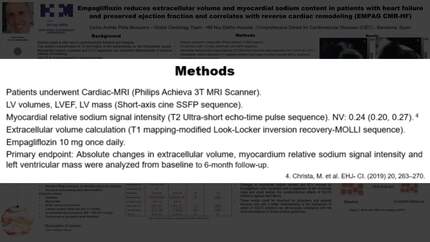
This study aimed to evaluate the short-term effects of SGLT2i on myocardial extracellular volume (ECV) and left ventricular (LV) systolic and diastolic function in patients with HFpEF and diabetes mellitus.
In this randomized prospective study, 32 patients with diabetes mellitus and HFpEF were assigned to receive either SGLT2i (treatment group) or placebo (control group) in addition to standard care. Assessments were conducted at baseline and after six months. Demographic and clinical characteristics were recorded. LV global longitudinal strain (LVGLS) was measured to assess systolic function, while left atrial peak strain (LAstrain) and the E/e’ ratio were used to evaluate diastolic function. Cardiac magnetic resonance imaging (MRI) was performed to measure ECV, T1, and T2 mapping as indicators of diffuse fibrosis and inflammation. Biomarkers, including C-reactive protein (CRP) and N-terminal pro-B-type natriuretic peptide (NT-proBNP), were also analyzed.
The mean age of participants was 67±9 years, with 62% being male. No significant differences were observed between groups at baseline. Over the study period, the treatment group showed significant improvements compared to the control group in LVGLS (Treatment group: from -16.4±1.7% to -17.2±2.5%, p=0.01 vs. Control group: from -17.5±1.9% to ‑17.3±2.4%, p=0.13), in LAstrain (Treatment group: from 13.95±2.01% to 15.53±2.00%, p<0.001 vs. Control group: from 13.90±1.83% to 13.60±1.80%, p=0.01), in E/e’ ratio (Treatment group: from 16.4±18 to 14.4±19, p=0.02 vs. Control group: from 10.5±6 to 11.6±8, p=0.11), in ECV (Treatment group: from 28.29±1.89% to 27.29±1.82%, p<0.001 vs. Control group: from 26.86±2.41% to 27.13±2.32%, p=0.16) and in CRP (Treatment group: from 2.77±2.51 to 1.98±1.64, p=0.01 vs. Control group: from 1.99±2.17 to 2.34±2.64, p=0.12).
In patients with HFpEF and diabetes mellitus, SGLT2i treatment improves both systolic and diastolic echocardiographic parameters, alongside reductions in ECV and CRP levels. These findings highlight the diverse mechanisms contributing to the cardioprotective effects of SGLT2i in this patient population.
Contributors


N Lama
Author
M Xenou
Author
P Theofilis
Author
V Tsigkou
Author
L Pliouta
Author
K Andreou
Author
V Lambadiari
Author
E Vavouranakis
Author
G Siasos
Author
D Tousoulis
Author
You may be interested in