Deciphering human heart failure with preserved ejection fraction (HFpEF) at single cell resolution
European Heart Journal


Abstract
Heart Failure with preserved ejection fraction (HFpEF) is a complex condition driven by diverse aetiologies and pathogenic mechanisms. It is one of the leading causes of death in industrialised nations. Despite its growing prevalence, therapies that improve survival remain largely unavailable, underscoring the need for a deeper understanding of the underlying disease mechanisms. The roles of different myocardial cell types and their contribution to disease progression remain largely elusive.
To identify myocardial cell type-specific disease mechanisms in HFpEF.
We performed single-nucleus RNA sequencing on endomyocardial biopsies from 6patients with HFpEF. The resulting dataset was integrated with a publicly available dataset of 12 myocardial samples from healthy donors. We obtained nuclei spanning all major cell types, including cardiomyocytes (CM), endothelial cells (EC), fibroblasts (FB), T cells and macrophages (MΦ).
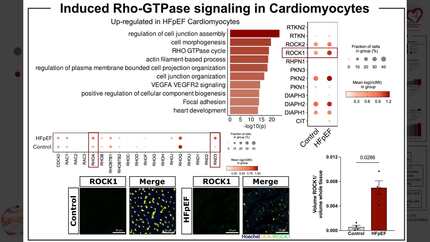
Differential Gene Expression analyses recapitulated hallmarks of HFpEF including metabolic alterations, inflammation, and fibrosis. In CM, we observed a metabolic shift with a downregulation of genes involved in fatty acid oxidation and aerobic respiration. This was accompanied by an upregulation in Rho/GTPase signalling, a pathway known to impair fatty acid oxidation and mitochondrial function, and induce CM hypertrophy – findings consistent with CM dysfunction in HFpEF.
In EC, we identified an upregulation of pro-inflammatory JUN/FOS and apoptosis markers (CASP3, CASP7) which may contribute to endothelial dysfunction and capillary rarefaction. We found increased signs of FB activation, as evidenced by increased expression of collagens and fibulins, along with an upregulation in TGF-β signalling, reinforcing the role of fibrosis in HFpEF. Interestingly, FB from HFpEF samples demonstrated reduced signs of interferon gamma (IFNγ) signalling, with a further decrease observed in activated FB. When treating primary cardiac human FB with recombinant IFNγ in vitro, we observed a reduced COL1A1 protein content. Conversely, both T cells and MΦ demonstrated increased responses to IFNγ, with T cells showing signs of enhanced IFNγ production - suggesting an intrinsic myocardial source of IFNγ.
In MΦ, we observed a robust upregulation of multiple MHC class II (MHC-II) genes and their upstream regulators (CIITA, LHMN, NFYA, NFYC, CLIP1). The expression of MHC-II genes correlated with the expression of IFNγ response genes. MHC-IIhigh MΦ exhibited a functional shift from phagocytosis toward a pro-inflammatory phenotype.
This study represents the first snRNA-Seq analysis of human HFpEF myocardium, revealing cell type-specific transcriptomic signatures associated with metabolic dysfunction, fibrosis and inflammation. Notably, the differential downstream effects of IFNγ across cell types suggest a novel mechanism that may serve as a potential therapeutic target in HFpEF treatment.
Contributors

S F Glaser
Author
M Ruz Jurado
Author
M Brandt
Author
D John
Author
D Rodriguez Morales
Author
W T Abplanalp
Author
T Procida-Kowalski
Author
M Bartkuhn
Author
L Nicin
Author
A M Zeiher
Author
P Wenzel
Author
E Nagel
Author
S Dimmeler
Author
You may be interested in