Impact of left ventricular hypercontractility on long-term survival in heart failure with preserved ejection fraction: a pressure-volume loop analysis
European Heart Journal


Abstract
Heart failure with preserved ejection fraction (HFpEF) is a heterogeneous condition, with treatment responses varying based on left ventricular (LV) ejection fraction (EF). Pressure-volume loop (PVL) analysis has identified two distinct hemodynamic phenotypes: one with low-normal EF, characterized by exercise-induced rightward shift, and another with high-normal EF, marked by LV hypercontractility and severe diastolic stiffness due to afterload excess.
This study aimed to determine whether LV hypercontractility affects long-term survival in HFpEF patients.
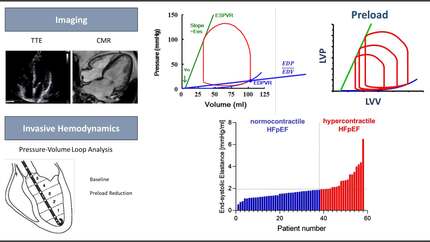
HFpEF patients underwent cardiac magnetic resonance imaging (CMR) before invasive PVL analysis at rest and during preload reduction via transient inferior caval vein occlusion. LV contractility was assessed by end-systolic elastance (Ees), while diastolic stiffness was evaluated using the end-diastolic pressure to indexed end-diastolic volume ratio (EDP/EDVi) and the β constant of the end-diastolic PV relation. Hypercontractile HFpEF was defined as the highest tertile of Ees, while the remaining patients were classified as normocontractile HFpEF (Figure 1 A+B). Long-term survival was analyzed using the log-rank test.
A total of 58 HFpEF patients were included, with a median follow-up of 1766 days (IQR 1253–3285). Baseline characteristics, including age, sex, medical history, and NYHA class, were similar between groups. Compared to normocontractile HFpEF, hypercontractile HFpEF patients had smaller LV volumes (EDVi: p=0.03, end-systolic volume: p=0.02) and higher EF (p=0.04). Despite similar end-diastolic pressures (p=0.24), hypercontractile HFpEF was associated with significantly elevated end-systolic pressure (161 vs. 146 mmHg, p=0.02), increased Ees (2.71 vs. 1.51 mmHg/ml, p<0.01), and higher arterial elastance (Ea: 2.01 vs. 1.72 mmHg/ml, p=0.01). The ventricular-arterial coupling ratio (Ees/Ea) was also higher in hypercontractile HFpEF (1.42 vs. 0.83, p<0.01), indicating a relative increase in systolic function. However, diastolic stiffness was more pronounced, with elevated EDP/EDVi (0.30 vs. 0.23, p=0.03) and a higher β constant (0.04 vs. 0.02, p<0.01).
While the coupling ratio itself did not significantly correlate with survival (p=0.29), hypercontractility was associated with worse long-term survival (p=0.01), Figure 2.
This study demonstrates that hypercontractile HFpEF, as identified by PVL analysis, is linked to poorer long-term survival. Although an increased coupling ratio suggests preserved systolic function, this comes at the expense of hypercontractility and heightened afterload sensitivity, leading to increased diastolic stiffness and impaired relaxation. These findings emphasize the need for novel therapeutic strategies targeting afterload and hypercontractility in HFpEF patients with high EF, a subgroup that has shown limited response to existing treatments.
Contributors

K P Kresoja
Author
A R Schoeber
Author
F Koppe-Schmeisser
Author
T Kister
Author
F Schlotter
Author
M Gutberlet
Author
H Thiele
Author
K Fengler
Author
P Lurz
Author
K P Rommel
Author
You may be interested in