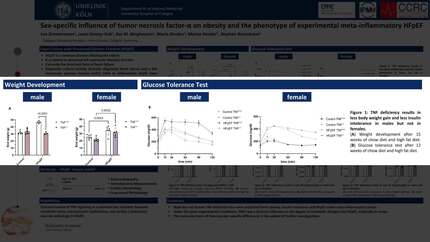
Sex-specific influence of tumour necrosis factor alpha on obesity and the phenotype of experimental meta-inflammatory HFpEF
European Heart Journal


Abstract
Heart failure with preserved ejection fraction (HFpEF) is an age-associated cardiometabolic disease associated with metabolic and inflammatory changes in cardiac tissue, pulmonary circulation and right ventricular dysfunction. Elevated tumour necrosis factor α (TNFα) levels are predictive of the risk of morbidity events in HFpEF. TNF-mediated metabolic responses may have a critical impact on both cardiac and pulmonary pathobiology. We therefore investigated the influence of TNF-deficiency on metabolism and the severity of HFpEF and its consequences in a gender-specific manner.
Meta-inflammatory HFpEF was induced in a mouse model by the combination of metabolic (high-fat diet [HFD]) and hypertensive stress (inhibition of constitutive NO synthase by Nω-nitro-1-arginomethyl ester (L-NAME) via drinking water) over a period of 15 weeks. The control group consisted of TNF+/+ and TNF-/- mice that received a normal chow diet. The phenotypic severity was determined by weight analyses, determination of insulin resistance and morphometric, echocardiographic and haemodynamic measurements of cardiopulmonary parameters. Left ventricular hypertrophy was quantified as the ratio of the wet weight of the left ventricle including septum to tibia length (LV+S/tibia). Right ventricular systolic pressure (RVSP) was measured using a Millar pressure catheter inserted into the right ventricle.
TNF-/- mice of both male (22.43±2.97 vs. 24.82±1.66g, p<0.05) and female (16.71±1.07 vs. 17.98±2.56g, p<0.01) sexes had slightly lower baseline weights than age-matched TNF+/+ control mice. Under HFpEF conditions (HFD + L-NAME), the weight gain of female animals increased equally in both genotypes (TNF-/-: +17.23±0.79g; TNF+/+: +17.37±2.91g, n.s.). In contrast, male TNF-/- mice showed a significantly lower weight increase compared to TNF+/+ mice (TNF-/-: +12.33±0.67g vs. TNF+/+: +21.38±0.93g; p<0.001). In addition, the glucose tolerance test in male mice in the HFpEF group also revealed a significant difference between TNF-/- (403.7±42.2 mg/dl) and TNF+/+ mice (549.0±39.0 mg/dl, p<0.01), while no difference between the genotypes was detected in female mice. Male TNF+/+ animals, but not TNF-/- mice, exhibited the features of HFpEF with left ventricular hypertrophy, as well as echocardiographic signs of diastolic LV dysfunction under HFD+L-NAME. In contrast, female TNF-/- and TNF+/+ mice developed comparable HFpEF. With regard to RVSP and Fulton index (RV/LV+S), there were no significant differences between the respective groups for both sexes.
Male TNF-deficient mice were protected from obesity, insulin resistance and HFpEF under conditions of meta-inflammatory stress. Under the given experimental conditions, TNFα has a decisive influence on the degree of metabolic changes and HFpEF, especially in males. The molecular basis of these gender-specific differences is the subject of further investigations.
Contributors

You may be interested in