Functional reserve and prognosis in hypercontractile phenotype patients with heart failure and preserved ejection fraction
European Heart Journal


Abstract
Transthoracic echocardiography (TTE) identifies a peculiar hypercontractile phenotype (HP) in patients with heart failure and preserved ejection fraction (HFpEF) with high resting left ventricular (LV) elastance (also called force).
To assess the functional response and its prognosis associated with HP in HFpEF by stress echocardiography (SE).
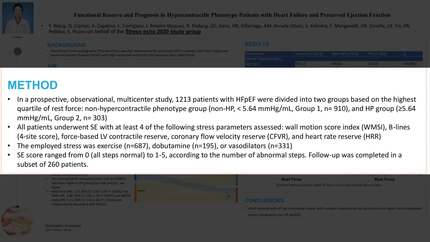
In a prospective, observational, multicenter study, 1213 patients with HFpEF were divided into two groups based on the highest quartile of rest force: non-hypercontractile phenotype group (non-HP, < 5.64 mmHg/mL, Group 1, n= 910), and HP group (≥5.64 mmHg/mL, Group 2, n= 303). All patients underwent SE with at least 4 of the following stress parameters assessed: wall motion score index (WMSI), B-lines (4-site score), force-based LV contractile reserve, coronary flow velocity reserve (CFVR), and heart rate reserve (HRR). The employed stress was exercise (n=687), dobutamine (n=195), or vasodilators (n=331). SE score ranged from 0 (all steps normal) to 1-5, according to the number of abnormal steps. Follow-up was completed in a subset of 260 patients.
The 2 groups showed similar values of peak stress WMSI but the global functional burden was higher in Group 2 patients: see table. In a subset of 260 patients who finished follow-up, there were 212 non-HP patients and 48 HP patients. During a median follow-up of 15 months (interquartile range: 10-20), 26 deaths, 20 heart failure (HF) rehospitalizations, and 64 major adverse cardiovascular events (MACEs) occurred. The cumulative HF rehospitalization rate and MACEs rate were higher in HP group (log-rank p<0.01): see figure. Rest force (HR, 1.17; 95% CI: 1.06-1.29; P: 0.040), rest SPAP (HR, 1.08; 95% CI: 1.02-1.14; P: 0.007) and ABCDE score (HR, 1.15; 95% CI: 1.01-1.66; P: 0.032) were independently associated with MACEs.
HFpEF patients with HP are functionally weaker with multiple vulnerabilities during stress and at higher risk of subsequent events compared to non-HP patients. Relation between resting values of force
Contributors


Q Ciampi
Author
A Zagatina
Author
L Cortigiani
Author
J Peteiro Vazquez
Author
R Padang
Author
G C Kane
Author
H R Villarraga
Author
A M Arruda-Olson
Author
E Kalinina
Author
F Manganelli
Author
H R Zanella
Author
L X Yin
Author
P A Pellikka
Author
E Picano
Author
You may be interested in