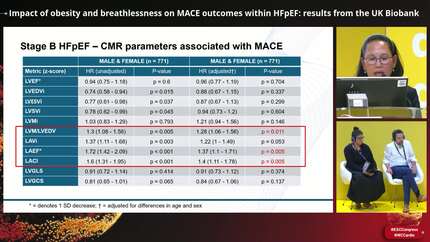
Impact of obesity and breathlessness on MACE outcomes within HFpEF: results from the UK Biobank
European Heart Journal


Abstract
Obesity is an independent risk factor for major adverse cardiovascular events (MACE) including heart failure (HF). HF with preserved ejection fraction (HFpEF) diagnosis is based on imaging criteria of preserved left ventricular (LV) ejection fraction (LVEF), increased indexed left atrial volume (LAVi) and/ or indexed LV mass (LVMi), alongside symptoms of breathlessness.
We investigated the impact of obesity on MACE in individuals with asymptomatic and symptomatic HFpEF.
UK Biobank participants without history of cardiovascular disease (CVD) who had cardiovascular magnetic resonance imaging (MRI) measurements of LVEF, LAVi, LVMi and body fat were included. Asymptomatic HFpEF was defined as individuals with LVEF ≥50%, LAVi >61/60 (M/F) ml/m2 and/or LVMi ≥76/57 g/m2 (M/F) without reported breathlessness (asymptomatic), while those with breathlessness (asymptomatic) were categorised as HFpEF. The analysis was repeated with a LAVi threshold of 34 ml/m2 based on transthoracic echocardiogram (TTE) as per recent ESC guidelines. Obesity was defined as BMI >30 kg/m2. Controls were asymptomatic, non-obese individuals with normal cardiac MRI. MACE was defined as first occurrence of coronary artery disease, atrial fibrillation, embolism/vascular events, HF, or stroke (from linked healthcare records). Multivariate hazard ratios (HR) were calculated from Cox proportional hazard models, adjusting for age, sex, history of dyslipidemia, hypertension and type 2 diabetes.
26,152 individuals were included with median follow-up of 4.6 years. Compared to asymptomatic, non-obese controls with no cardiac abnormalities, asymptomatic HFpEF was associated with increased risk of MACE, regardless of obesity status: non-obese, asymptomatic HFpEF [HR 2.0 (95% CI 1.7-2.4)] vs. obese asymptomatic HFpEF [HR 2.1 (1.6-2.8)]. The risk of MACE was greater in individuals with symptomatic HFpEF, when compared to individuals with asymptomatic HFpEF. However, non-obese HFpEF demonstrated the highest risk of MACE [HR 5.6 (3.2-9.9)] (obese HFpEF [HR 3.5 (2.2-5.4)]). Findings based on the TTE-derived LAVi threshold were similar.
Asymptomatic HFpEF is associated with an increased risk of major adverse cardiovascular events, regardless of obesity status. In symptomatic HFpEF with breathlessness, obesity may have a more favourable prognosis than those without obesity, suggesting the existence of an obesity paradox in HFpEF. Demographics table Adjusted proportional hazard ratios
Contributors

M Mahmod
Author
H Thomaides Brears
Author
C Diamond
Author
I Popescu
Author
T Kailayanathan
Author
S Bull
Author
N Desai
Author
R Banerjee
Author
A Banerjee
Author
You may be interested in