Native QRS duration and outcomes in heart failure with mildly reduced ejection fraction: results from a large-scaled registry
European Heart Journal


Abstract
The study investigates the prognostic impact of the native QRS duration in patients with heart failure with mildly reduced ejection fraction (HFmrEF).
The prognostic impact of QRS duration in HFmrEF has poorly been investigated.
Consecutive patients with HFmrEF were retrospectively included at one institution from 2016 to 2022. Patients with QRS duration ≥120 ms were compared to patients with QRS duration <120 ms, further risk stratification was performed comparing patients with left and right bundle branch block (LBBB vs. RBBB). The primary endpoint was all-cause mortality at 30 months, secondary endpoints comprised amongst others the risk of HF-related rehospitalization.
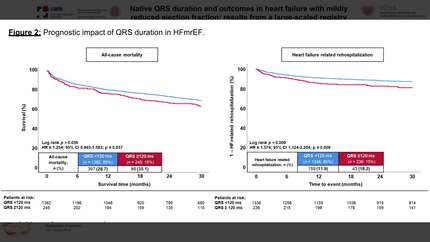
In total, 1,627 patients with HFmrEF were included with a median QRS duration of 90 ms (QRS duration ≥120 ms: 15%). Although the risk of long-term all-cause mortality was not affected by a prolonged QRS duration (35.1% vs. 28.7%; p = 0.057; HR = 1.254; 95% CI 0.993 – 1.583), patients with QRS duration ≥120 ms had a higher risk of HF-related rehospitalization (18.2% vs. 11.9%; p = 0.008; HR = 1.574; 95% CI 1.124 – 2.204). A QRS duration ≥120 ms was associated with long-term HF- related rehospitalization even after multivariable adjustment (HR 1.413, 95% CI 1.002 – 1.992, p = 0.049). Finally, the risks of long-term all-cause mortality and HF-related rehospitalization did not differ among patients with LBBB and RBBB.
A prolonged QRS duration is independently associated with a higher risk of HF-related rehospitalization in HFmrEF, but not long-term all-cause mortality.
Contributors

F Kronberg
Author
M Behnes
Author
M Reinhardt
Author
A Schmitt
Author
N Abel
Author
F Lau
Author
H J Steffen
Author
K Weidner
Author
M Abumayyaleh
Author
J Kuschyk
Author
I Akin
Author
You may be interested in