Predicting factors of right ventricular-pulmonary artery uncoupling assessed by TAPSE/PASP ratio after discharge in patients with heart failure and mildly reduced ejection fraction
European Heart Journal


Abstract
The development of right ventricular (RV)-pulmonary arterial (PA) coupling has resulted in a novel and comprehensive index for evaluating RV function in relation to the underlying RV afterload. Its prognostic significance in heart failure with mid-range ejection fraction (HFmrEF) is increasingly recognized. The RV-PA coupling index can be readily assessed non-invasively using the ratio of two standard echocardiographic measurements: tricuspid annular plane systolic excursion (TAPSE) and pulmonary artery systolic pressure (PASP). However, factors predicting a low TAPSE/PASP ratio after discharge remain unclear.
This study aims to identify discharge-related factors associated with low TAPSE/PASP ratio in HFmrEF patients during follow-up.
From the cohort study of 4,629 hospitalized HF patients (age 68+/-15, men 62%) between August 2015 and September 2023, this study enrolled 226 HFmrEF (i.e., left ventricular ejection fraction (LVEF) 41–49%) patients whose TAPSE and PASP were measured at 1 year after discharge. A low TAPSE/PASP ratio was defined as median value. Clinical, laboratory, and echocardiographic parameters at discharge were analyzed to identify predictors of a low TAPSE/PASP ratio post-discharge using multivariate logistic regression.
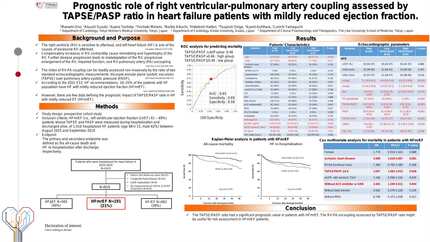
During median follow-up of 29 [13–41] months, 31 patients (14%) died. Median TAPSE/PASP ratio was 0.51. Patients with TAPSE/PASP <0.51 had a significantly higher all-cause mortality (log-rank p<0.05) and had a significantly higher rate of HF re-hospitalization than patients with TAPSE/PASP ≥0.51 (log-rank p<0.05) (Figure). Multivariate analysis revealed that ACE-inhibitor/ARB/ARNI non-use, higher BNP level and lower TAPSE/PASP ratio before discharge were independently associated with a low TAPSE/PASP ratio after discharge (Table).
In HFmrEF patients, a low post-discharge TAPSE/PASP ratio was associated with poorer survival outcomes after discharge. Renin-Angiotensin-Aldosterone System inhibitors, BNP level and baseline low TAPSE/PASP ratio were significant predictors of low TAPSE/PASP ratio post-discharge in HFmrEF patients. These findings emphasize the importance of early identification of these parameters or medications for optimizing post-discharge management and improving outcomes. Kaplan-Meier analysis Multivariate analysis
Contributors


Y Fukunaga
Author
A Mikami
Author
A Nokubo
Author
M Kishihara
Author
T Koike
Author
S Shirotani
Author
E Shibahashi
Author
Y Minami
Author
N Kikuchi
Author
H Hattori
Author
J Yamaguchi
Author
You may be interested in