Prevalence and prognostic impact of malignancies in patients with HFmrEF: results from a large-scale retrospective registry
European Heart Journal


Abstract
The study investigates the prevalence and prognostic impact of the presence and type of malignancies in patients with heart failure with mildly reduced ejection fraction (HFmrEF).
Patients with malignancies were commonly excluded from randomized heart failure trials. Little is known about the prevalence and prognostic impact of malignancies in HFmrEF.
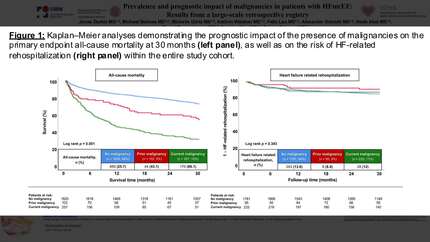
Consecutive patients with HFmrEF were retrospectively included at one institution from 2016 to 2022. Patients with malignancies were compared to patients without, further risk stratification was performed by the type (i.e., solid, heamato-oncological) of malignancies. The primary endpoint was all-cause mortality at 30 months (median follow-up), key secondary endpoint was the risk of HF-related rehospitalization.
From a total of 2,184 patients hospitalized with HFmrEF, 348 (15.9%) suffered from malignancies (12.6% current; 3.3% prior). Most patients had solid maligiancies (11.5%), whereas 4.0% had hemato-oncological maliganancies (both types: 0.4%). The presence of malignancies was significantly associated with a higher risk of all-cause mortality at 30 months (49.5% vs. 25.9%; log rank p =0.001; HR = 3.239). After multivariable adjustment, the presence of malignancies was associated with a 3-fold increased risk of long-term all-cause mortality (HR=3.212; 95% CI 2.679-3.851; p=0.001). However, the risk of long-term all-cause mortality did not differ among patients with solid or hemato-oncological malignancies (58.7% vs. 59.8%; log rank p=0.187) Finally, the presence of malignancies was not associated with the risk of HF-related rehospitalization at 30 months (11.0% vs. 13.6%; log rank p=0.244).
Malignancies are common in patients with HFmrEF with a prevalence of 16% and independently associated with a 3-fold increased risk of long-term all-cause mortality.
Contributors

You may be interested in