Prognostic implications of multimorbidity in patients with heart failure with mildly reduced ejection fraction
European Heart Journal


Abstract
The study investigates the prevalence and prognostic impact of multimorbidity in patients hospitalized with heart failure (HF) with mildly reduced ejection fraction (HFmrEF).
Related to ongoing demographic changes and the ageing population, the number of patients with cardiac and non-cardiac comorbidities and specifically the proportion of patients with multimorbidity increases.
Consecutive patients hospitalized with HFmrEF were retrospectively included at one institution from 2016 to 2022. Patients were divided into four groups (i.e. 0-1, 2-3, 4-5, ≥6 comorbidities) based on the number of concomitant comorbidities taking into account a total of 12 comorbidities (i.e,. anemia, arterial hypertension, atrial fibrillation/flutter, prior/acute myocardial infarction, obesity, stroke, peripheral artery disease, diabetes mellitus, chronic kidney disease, malignancy, liver cirrhosis, and chronic obstructive pulmonary disease). The prognostic impact of the number of comorbidities was investigated with regard to the primary endpoint of all-cause mortality at 30 months (median follow-up).
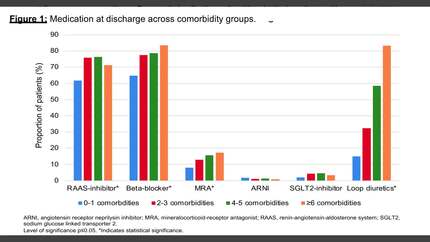
From a total of 2,184 patients hospitalized with HFmrEF, 36% presented with 4-5 and 16% with ≥6 comorbidities. The most common comorbidities were arterial hypertension (78%), anaemia (51%) and atrial fibrillation/flutter (44%). Compared to patients with 4-5, 2-3, 0-1 comorbidities patients with ≥6 comorbidities were more likely to be discharged with beta blockers (84.0% vs. 79.1% vs. 77.2% vs. 64.3%; p = 0.001), loop diuretics (84.3% vs. 56.7% vs. 35.3% vs. 15.6%; p = 0.001) and mineralocorticoid receptor antagonists (MRA) (18.6% vs. 15.2% vs. 12.8% vs. 8.0%; p = 0.003). However, the rates of treatment with sodium-glucose linked transporter 2 (SGLT2) inhibitors were higher in patients with 4-5 comorbidities (5.7% vs. 4.4% in patients with ≥6 comorbidities vs. 2.8% in patients with 2-3 comorbidities vs. 1.8% in patients with 0-1 comorbidities; p = 0.001). The risk of all-cause mortality at 30 months increased with the number of comorbidities and was higher in patients with ≥6 comorbidities compared to patients with less (i.e., 4-5, 2-3, 0-1) comorbidities (55.3% vs. 37.5% vs. 21.4% vs. 8.9%, p = 0.001). Accordingly, an increasing number of comorbidities was associated with a higher risk for rehospitalization due to HF worsening (29.6% vs. 15.1% vs. 7.8% vs. 3.6%, p = 0.001).
In patients hospitalized with HFmrEF, more than 50% presented with at least 4 comorbidities. Multimorbidity in HFmrEF was independently associated with worse outcomes.

You may be interested in