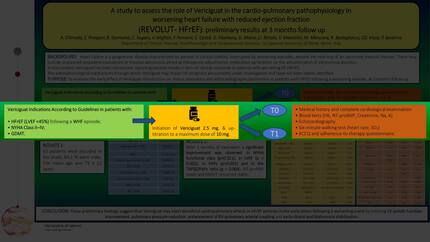
A study to assess the role of vericiguat in the cardio-pulmonary pathophysiology in worsening heart failure with reduced ejection fraction (REVOLUT- HFrEF): preliminary results at 3 months follow up
European Heart Journal


Abstract
Heart Failure (HF) is a multisystemic disease which initially affect heart and progressively involves other organs, such as lungs and kidneys determining, in the advanced phases, the cardio-pulmonary and cardio-renal syndrome. It is also a progressive disease characterized by periods of clinical stability interrupted by worsening episodes, which are even more frequent and prolonged, despite the reaching of an optimized medical therapy. These episodes are characterised by a worsening of HF symptoms and signs, needing urgent outpatient visits, hospitalization and intravenous diuretics administration. In this context, Vericiguat, a novel soluble guanylate cyclase (sGC) stimulator, has been introduced, reporting appreciable results in term of clinical outcomes in patients with worsening HF. However, the study of pathophysiological mechanisms through which Vericiguat may impact on HF prognosis and progression is currently not investigated yet.
To evaluate the early effect of Vericiguat introduction on clinical, laboratory and echocardiographic parameters in patients with HFrEF following a worsening episode, at 3 months follow up.
The present is an observational, prospective, single centre study, enrolling patients with HFrEF who started Vericiguat in the outpatient setting, on top of the optimized medical therapy for HF, following a clinical/subclinical worsening episode. Patients represented a single study group. Clinical, laboratory and echocardiographic parameters have been assessed at baseline and at 3 months follow up.
A total of 29 patients have been enrolled between November 2023 and September 2024 and they were followed up for a period of 3 months. All the patients reached the target dose of 10 mg within 1 month of drug initiation and maintained the target dose throughout the study period. Mean age was 73.5 (±8), 86.2% of patients were male and mean LVEF was 29% (±7). A statistically significant improvement in LVEF (p=0.01), a reduction in LVEDD (p=0.045), PAPs (p=0.006), TRPG (p=0.04), RVEDD (p=0.048) and an improvement in TAPSE/PAPs ratio (p=0.021) have been observed at 3 months follow up. No statistically significant differences have been observed in term of other laboratory, clinical and echocardiographic parameters.
These preliminary results suggest that Vericiguat may early induce left ventricle systolic function improvement, left and right ventricle reverse remodelling, right ventricle unloading and right ventricle-pulmonary arterial coupling improvement in patients with HFrEF and recent worsening episode. Vericiguat may also induce an early clinical and biohumoral stabilisation, as demonstrated by the absence of significant variation of NT proBNP, KCCQ-23 score and meters walked at 6-minute walking test, parameters that often get worse in patients with recent worsening episode.
Contributors


C Segato
Author
S Prosperi
Author
V Myftari
Author
F Ferranti
Author
C Cestie
Author
D Filomena
Author
C Manzi
Author
L I Birtolo
Author
V Maestrini
Author
M Mancone
Author
R Badagliacca
Author
C D Vizza
Author
P Severino
Author
You may be interested in