Revolutionizing heart failure management: insights from impedance cardiography
European Heart Journal


Abstract
Heart failure (HF) is a complex condition associated with high morbidity and mortality. Optimizing pharmacological treatment is crucial for improving cardiac function and hemodynamics in patients. Impedance cardiography (ICG) is a non-invasive method that plays a crucial role in monitoring patients with HF, allowing for continuous and accurate assessment of hemodynamic parameters.
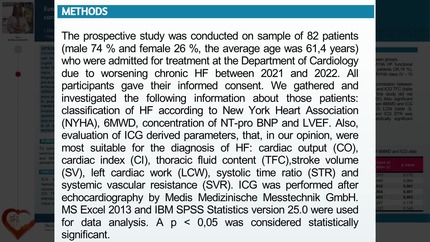
We conducted a prospective monocentric study at the cardiology department of our university hospital involving 120 patients over 18 years old, presenting with chronic heart failure and reduced left ventricular ejection fraction (LVEF). All patients received optimized treatment defined by optimal or maximally tolerated doses of the four pillars of HFrEF treatment including beta-blockers, angiotensin-converting enzyme inhibitors or Sacubitril-Valsartan, aldosterone antagonists, and SGLT2 inhibitors. Hemodynamic assessments using ICG were performed at baseline and after 3 months of optimized treatment. Measured parameters included stroke volume (SV), cardiac output (CO), cardiac index (CI), systemic vascular resistance index (SVRI), left cardiac work index (LCWI) and thoracic fluid content (TFC).
After 3 months of optimized treatment, we observed a significant increase in SV (from 69.47 ± 21.23 ml to 81.05 ± 23.70 ml, p = 0.019) and cardiac output (from 4.92 ± 1.14 l/min to 5.80 ± 1.47 l/min, p = 0.017). Similarly, the cardiac index improved significantly (from 2.71 ± 0.57 l/min/m² to 3.16 ± 0.70 l/min/m², p = 0.036). A substantial reduction in systemic vascular resistance index was observed (from 2415.09 ± 589.21 dyn·s/cm⁵ to 2056.48 ± 438.40 dyn·s/cm⁵, p = 0.021), indicating better vascular compliance. Furthermore, the left cardiac work index increased markedly (from 2.75 ± 0.76 kg·m/m² to 3.73 ± 2.61 kg·m/m², p = 0.006), reflecting enhanced myocardial performance. Although thoracic fluid content remained unchanged (24.06 ± 5.62 1/kOhm to 24.36 ± 6.35 1/kOhm, p = 0.754), these results indicate an improvement in hemodynamics among treated patients. ICG facilitated the monitoring of these changes non-invasively, providing a valuable tool for real-time treatment adjustments.
Optimizing heart failure treatment led to significant improvements in hemodynamic parameters measured by ICG. These results highlight the importance of an integrated therapeutic approach and the crucial role of ICG in patient monitoring, and treatment selection by enabling dynamic profiling of hemodynamic parameters, facilitating personalized therapy adjustments to optimize the management of patients with heart failure.



You may be interested in