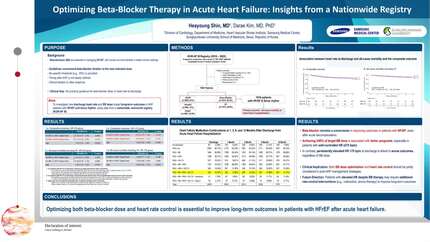
Optimizing beta-blocker therapy in acute heart failure: insights from a nationwide registry
European Heart Journal


Abstract
Beta-blockers (BB) are a cornerstone in the management of heart failure with reduced ejection fraction (HFrEF). While guidelines recommend dose up-titration and maintaining heart rates around 70 beats per minute (bpm), their role in acute heart failure (AHF) remains uncertain, particularly in the context of newer therapies such as sodium-glucose cotransporter-2 inhibitors (SGLT2i). This study evaluates the impact of discharge heart rate and BB dose on long-term outcomes in patients discharged after AHF hospitalization.
We analyzed data from the KOR-HF III registry, a prospective, multicenter study including 7,351 AHF patients across 47 Korean hospitals (2018–2022). After excluding patients with ventricular assist devices, restrictive cardiomyopathy, and amyloidosis, 1,916 HFrEF patients with sinus rhythm were included. Propensity score matching was performed to adjust for confounders. The primary endpoint was a composite of all-cause mortality or heart failure hospitalization
While Kaplan-Meier analysis showed no difference in composite outcomes between heart rate groups, Cox regression analysis revealed a significantly increased risk in the HR >70 bpm group (HR=1.46, 95% CI 1.09-1.96, p=0.01) In patients with HR ≤70 bpm, those receiving ≥50% of the target BB dose had a 53% lower risk of the composite outcome (HR=0.47, 95% CI: 0.25-0.88, p=0.018), reinforcing the importance of dose optimization. In patients with HR >70 bpm, higher BB dose alone was not associated with a significant reduction in adverse outcomes, suggesting that both BB titration and heart rate control should be considered in clinical decision-making rather than focusing on either factor in isolation.
This study reinforces the established role of BB therapy in improving outcomes in HFrEF and highlights the importance of both dose optimization and heart rate control in post-AHF management. While achieving guideline-directed BB dosing remains beneficial, patients with persistently elevated HR >70 bpm may require additional rate-control strategies to optimize outcomes.

You may be interested in