Association of myocardial damage assessed by 99mTc-MIBI scintigraphy with exercise capacity and clinical outcomes in patients with heart failure
European Heart Journal


Abstract
Exercise capacity is an important prognostic factor in patients with heart failure (HF). The percentage of predicted peak oxygen consumption (PPVO₂), an objective measure of exercise capacity assessed by cardiopulmonary exercise testing (CPET), is valuable in predicting HF prognosis. Decreased myocardial uptake on resting technetium-99 m sestamibi (99mTc-MIBI), including a high summed rest score (SRS), reflects myocardial damage and is associated with poor prognosis in ischaemic cardiomyopathy. However, in non-ischaemic cardiomyopathy (NICM), the relationship between decreased 99mTc-MIBI uptake and exercise capacity or prognosis remains unclear.
To investigate whether myocardial damage, assessed by decreased uptake of 99mTc-MIBI, contributes to impaired exercise capacity and adverse clinical outcomes in patients with NICM.
We retrospectively analyzed 182 NICM patients (mean age 51.4 ± 14.0 years; 27% female) with a left ventricular ejection fraction < 50% who underwent 99mTc-MIBI scintigraphy and CPET during hospitalisation at our hospital between June 2016 and June 2023. Myocardial uptake of 99mTc-MIBI was evaluated using the SRS. Patients were stratified based on PPVO₂ (≤ 60% vs. > 60%) to compare patient characteristics, SRS, and clinical outcomes defined as a composite of all-cause death, ventricular assist device implantation and heart transplantation.
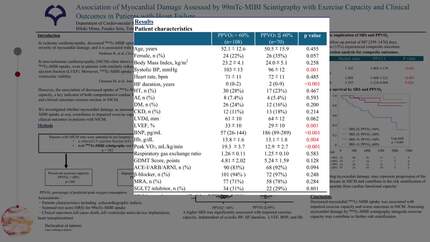
PPVO₂ was ≤ 60% in 74 patients (41%). The SRS was significantly higher in the PPVO₂ ≤ 60% group than in the PPVO₂ > 60% group (12 [IQR 7-18] versus 8 [IQR 5-12], p < 0.001). During a median follow-up of 807 days ([IQR 359 - 1476]), 23 patients (13%) experienced composite outcomes. Higher SRS was significantly associated with worse outcomes (HR 1.102, 95% CI: 1.065 - 1.139, p < 0.001). In multivariate cox proportional hazards analysis, which included SRS and PPVO₂ ≤ 60%, SRS remained significant predictors of worse outcomes, along with PPVO₂ ≤ 60% (HR 1.085, 95% CI: 1.048 - 1.123, p < 0.001) and PPVO₂ ≤ 60% (HR 3.197, 95% CI: 1.124 - 9.094, p = 0.020). Kaplan-Meier survival curves, stratified by the median SRS value of 9 and a PPVO₂ value of 60%, showed significant overall differences in the risk of composite events (log-rank p < 0.001). Among the four groups, patients with low PPVO₂ and high SRS had the highest risk. (Figure)
Inpatients with non-ischaemic cardiomyopathy, myocardial damage, indicated by decreased uptake of 99mTc-MIBI, was associated with impaired exercise capacity and poor clinial outcomes. In these patinets, assessing myocardial damage by 99mTc-MIBI scintigraphy alongside exercise capacity may contribute to further risk stratification. Kaplan-Meier Survival Curves

You may be interested in