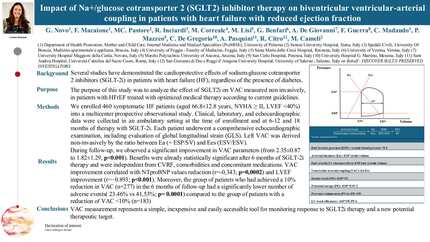
Impact of Na+/glucose cotransporter 2 (SGLT2) inhibitor therapy on biventricular ventricular-arterial coupling in patients with heart failure with reduced ejection fraction
European Heart Journal


Abstract
Several studies have demonstrated the cardioprotective effects of Sodium-glucose co-transporter 2 inhibitors (SGLT-2i) in patients with heart failure (HF), irrespective of the presence of diabetes.Impact on ventricular-arterial coupling (VAC) havent’t been investigated to far.
The purpose of this study was to analyze the effect of SGLT2i on VAC measured non invasively, in patients with HFrEF treated with optimized medical therapy according to current guidelines.
We enrolled460 symptomatic HF patients (aged66.8±12.8, NYHA ≥ II, LV ejection fraction< 40%) into a multicentric prospective observational study; clinical, laboratory and echocardiographic data were collected in an ambulatory setting, at time of enrolment and after 6-12 and 18 months of therapy with SGLT-2i.
Each patient underwent a comprehensive echocardiographic examination including evaluation of deformation imaging parameters and particularly GLS (global longitudinal strain) at baseline and during follow up.
Left VAC was derived non invasively by the ratio between Ea (= ESP/SV) and Ees (ESV/ESV).
During follow up we observed a significant improvement on VAC parameters(from 2.35± 0.87 to 1.82±1.29, p<0.001).Benefits were already statistically significant after 6 months of SGLT-2i therapy and were independent from CVRF, comorbidities and concomitant medications. VAC improvement correlated with NTproBNP values reduction(r=-0,343; P=0,0002)and LVEF improvement(r=−0.893; p<0.001). Moreover, the group of patients who had achieved a 10% reduction in VAC (n=277) in the 6 months of follow-up had a significantly lower number of adverse events( 23.46% vs 41,53%; p= 0.0001) compared to the group of patients with a reduction ofVAC <10% (n=183)
Our study demonstrated a significant impact of SGLT-2ion VAC parameters and a better prognosis pf patients with VAC improvement. This study represent a further step forward to understand the pathophysiological mechanisms underlying the extraglicemic benefits produced by SGLT2-i therapy on the cardiovascular homeostasis.
VAC measurement represents a simple, inexpensive and easily accessible tool for monitoring response to SGLT2i therapy and a new potential therapeutic target.
Contributors


F Macaione
Author
M C Pastore
Author
R Inciardi
Author
M Correale
Author
M Lisi
Author
G Benfari
Author
A De Giovanni
Author
F Guerra
Author
C Madaudo
Author
P Mazzeo
Author
C De Gregorio
Author
A Pasquini
Author
R Citro
Author
M Cameli
Author
You may be interested in