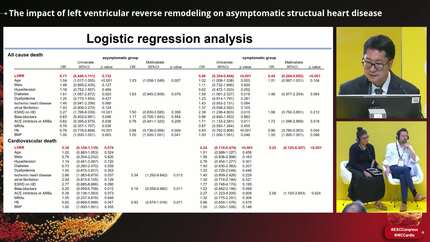
The impact of left ventricular reverse remodeling on asymptomatic structual heart disease
European Heart Journal


Abstract
Recent clinical guidelines emphasize left ventricular ejection fraction (LVEF) as a key factor in therapeutic decision-making, making its trajectory increasingly important. Left ventricular reverse remodeling (LVRR) is frequently observed in patients with symptomatic heart failure (HF) with reduced LVEF and is associated with a favorable prognosis. However, its prognostic significance in asymptomatic structural heart disease remains unclear.
This study aimed to compare the prognostic significance of LVRR in patients with symptomatic HF and asymptomatic structural heart disease.
We retrospectively analyzed 1,147 patients (mean age 63 ± 14 years, 70% male) newly diagnosed with LVEF <50% by echocardiography. Follow-up echocardiography was performed within two years. Diuretic prescription was used as a surrogate marker to classify patients into asymptomatic and symptomatic groups. HF was categorized by LVEF as follows: HFrEF (≤40%), HFmrEF (40–49%), and HFpEF (≥50%). LVRR was defined as an LVEF improvement of ≥10% with a shift to a higher LVEF category. Kaplan-Meier analysis assessed all-cause and cardiovascular mortality, with comparisons based on LVRR using the log-rank test. Logistic regression evaluated LVRR’s predictive value for mortality. Causes of death were determined from death certificates.
Baseline characteristics, including age, sex, BMI, and comorbidities (hypertension, diabetes, coronary artery disease), were similar between groups. However, the symptomatic group had a significantly lower baseline LVEF (36% vs. 41%, p < 0.001) and higher BNP levels (412.3 ± 586.3 vs. 330.7 ± 852.7, p < 0.001). Guideline-directed medical therapy was more frequently prescribed in the symptomatic group. LVRR incidence was comparable (40.0% vs. 41.3%, p = 0.525). In symptomatic patients, LVRR was associated with improved all-cause (p = 0.036) and cardiovascular mortality (p < 0.001). However, LVRR had no significant impact on mortality in the asymptomatic group. Multivariate analysis showed LVRR as a strong predictor of mortality in symptomatic patients (all-cause: OR 0.443, 95% CI 0.284–0.692, p < 0.001; cardiovascular: OR 0.252, 95% CI 0.125–0.507, p < 0.001). Cardiovascular deaths were significantly more frequent in the symptomatic group (40.0% vs. 20.8%, p < 0.001).
LVRR is associated with improved outcomes in symptomatic HF but has limited prognostic impact in asymptomatic structural heart disease. Although LVRR is a favorable sign in symptomatic HF patients, it may not be useful in populations with a low incidence of cardiovascular death, suggesting that in the asymptomatic group, factors other than LVRR may play a greater role in determining outcomes. Kaplan–Meier of All-cause mortality Kaplan–Meier of Cardiovascular mortality

You may be interested in