Low-valine diet ameliorates pathological cardiac hypertrophy by inhibiting LONP1-mediated ATP5F1B degradation
European Heart Journal


Abstract
An accumulated valine in cardiomyocytes under hypertension is associated with pathological cardiac hypertrophy. Therefore, a low-valine diet may be effective in the amelioration of cardiac hypertrophy.
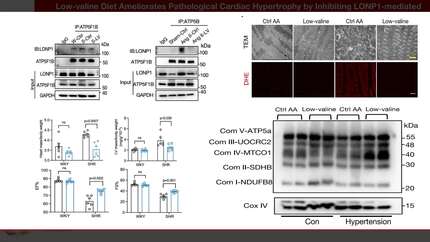
This study utilised the NHANES database to investigate the association between elevated dietary valine intake and the risk of developing cardiovascular disease. Utilising a combination of a L-valine agarose bead construction through a pull-down assay and mass spectrometry analysis, it was ascertained that ATP5F1B exhibited a significant binding affinity for valine in hypertensive cardiac tissues. Moreover, immunofluorescence co-localisation studies elucidated that an augmentation in the concentration of FITC-L-valine led to a diminution in ATP5F1B expression within cardiomyocytes. In vitro and in vivo, it verified that a low-valine diet improved mitochondrial structure and function in cardiomyocytes by increasing ATP5F1B protein expression, reduced oxidative stress injury, and attenuated pathological cardiac hypertrophy in hypertension. Furthermore, through myocardial-specific overexpression and interference with Atp5f1β, it was demonstrated that the valine diet could regulate ATP5F1B expression to affect mitochondrial structural function and oxidative stress, as well as to have an effect on hypertensive pathological cardiac hypertrophy and cardiac function. Co-IP coupled with mass spectrometry analysis revealed that ATP5F1B binding to LONP1 was increased in the high valine environment of cardiomyocytes, and we demonstrated that low valine diet could improve the mitochondrial structural function and reduce oxidative stress injury, and reduce hypertension pathological cardiac hypertrophy and cardiac function. Co-IP confirmed that LONP1 binding to ATP5F1B was reduced and ATP5F1B expression was increased in cardiac tissues of hypertensive animals on a low-valine diet. PDB prediction of the three binding sites revealed mutations in the relevant residues (316A ASP, 328A VAL and 330A ARG), and the construction of mutation sites and in vitro experiments revealed that 330A ARG was the keysite.
This study investigated the role and molecular mechanism of low-val diet in ameliorating pathological cardiac hypertrophy in hypertension, which constructed at multiple levels, including molecular, cellular and animal.

You may be interested in