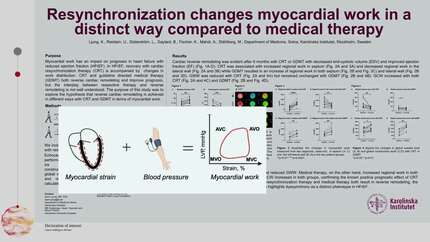
Cardiac reverse remodeling induced by cardiac resynchronization therapy results in distinct changes in myocardial work when compared to guideline directed medical therapy
European Heart Journal


Abstract
Heart failure with reduced ejection fraction (HFrEF) is characterized by cardiac remodeling and dyssynchrony aggravates this process. Both cardiac resynchronization therapy (CRT) and guideline directed medical therapy (GDMT) reverse remodeling and reduce mortality in HFrEF. However, the interplay between respective therapy and reverse remodeling is not well understood. Myocardial work, derived from echocardiography, is associated with energy consumption and is a prognostic marker in HFrEF. Since CRT has a positive inotropic effect, that GDMT lacks, we hypothesized that reverse remodeling is achieved in different ways in terms of myocardial work.
To characterize the remodeling process achieved with CRT compared to GDMT.
We included 15 CRT patients that displayed reverse cardiac remodeling, ≥15% reduction in left ventricular end-systolic volume (ESV) and/or ≥7% increase in ejection fraction (EF). A control group (n=9) with newly diagnosed HFrEF with QRS <120ms who displayed reverse remodeling due to guideline directed medical therapy (GDMT) was also assessed. Echocardiography was performed at baseline and six months. Blood pressure and global longitudinal strain was used to calculate global constructive work (GCW), global wasted work (GWW) and regional myocardial work.
Cardiac reverse remodeling was evident after 6 months with a decrease in ESV from 111 ml ± 59 to 65 ml ± 28 (p<0.01) with CRT and 124 ml ± 55 to 70 ml ± 37 (p<0.01) with GDMT. EF improved from 37% ± 10 to 46% ± 13 (p<0.01) with CRT and 33% ± 10 to 49% ± 11 (p<0.01) with GDMT. CRT was associated with increased regional work in septum (p<0.0001, Fig.1A) and decreased regional work in the lateral wall (p <0.01, Fig. 1B) while GDMT resulted in an increase of regional work in both septum (p<0.01, Fig. 1C) and lateral wall (p<0.01, Fig. 1D). CRT resulted in a reduction in GWW (p<0.01, Fig. 2A) while GWW remained unchanged with GDMT (Fig 2B). GCW increased with both CRT (p<0.05, Fig. 2C) and GDMT (p<0.05, Fig. 2D).
Resynchronization redistributes work to the septum and reduces GWW. Medical therapy on the other hand, increases regional work in both septum and lateral wall but GWW is not affected. GCW increased in both groups, confirming the known positive prognostic effect of CRT and GDMT. These results indicate that, even though resynchronization therapy and medical therapy both result in reverse remodeling, the mechanisms are different, which highlights dyssynchrony as a distinct phenotype in HFrEF. Changes in regional work Changes in wasted and constructive work


You may be interested in