Reverse cardiac remodeling following with sacubitril/valsartan in heart failure: comparison between ischemic and non-ischemic etiology
European Heart Journal


Abstract
Sacubitril/valsartan induces reverse ventricular remodeling (RR) and improves outcomes in patients with heart failure and reduced ejection fraction (HFrEF).
This study sought to determine whether patients with HFrEF of ischemic etiology have similar reverse cardiac remodeling with sacubitril/valsartan as patients with non-ischemic etiology.
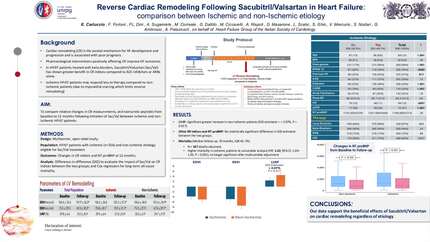
In this multicenter, open-label study, we examined changes in measures of cardiac remodeling, and natriuretic peptides from baseline to 12 months following initiation of sacubitril/valsartan between HFrEF patients with and without ischemic etiology. The difference-in-difference (DiD) analysis was used to evaluate the impact of sacubitril/valsartan on RR indices between the two groups. Long term all-cause mortality was also analyzed by Cox regression.
Among 608 patients enrolled, 302 (49.7%) had ischemic etiology. At baseline, NT-proBNP concentrations did not differ between patients with versus without ischemic etiology and they were similarly reduced after initiation of sacubitril/valsartan (- 604.7 pg/dL versus -401.6 pg/dL, P=NS). Improvement was observed in LV ejection fraction (ischemic: +2.44% vs. non-ischemic: +4.5% at 12 months), end-diastolic volume index (ischemic: -3.85 mL7m2 vs. non-ischemic: -4.98 mL/m2, P<0.001), and end-systolic volume index (ischemic: -4.88 mL7m2 vs. non-ischemic: -7.42 mL/m2, P<0.001).
Compared to ischemic etiology (n = 354), DiD analysis showed a relative greater increase in LV ejection fraction in non-ischemic patients (DiD estimator = + 2.07%, P = 0.017). The difference in other indices of RR and NT-proBNP was not statistically different.
After a median follow-up of 70 months (IQR 45-79), 167 patients died. Although at univariable analysis mortality was greater in ischemic compared to non-ischemic patients (HR 1.42, 95%CI: 1.04-1.93, P=0.025), ischemic etiology was no longer significant in multivariable analysis.
although fewer benefits from guideline-directed medical therapy may be often seen in HFrEF patients of ischemic etiology, our data provide reassuring evidence for the beneficial impact of sacubitril/valsartan on important mechanistic outcomes regardless of HFrEF etiology
Contributors

F Fortuni
Author
F L Dini
Author
A Sugamiele
Author
M Correale
Author
G Dattilo
Author
M Ciccarelli
Author
A Rispoli
Author
D Masarone
Author
L Scelsi
Author
S Ghio
Author
V Mercurio
Author
S Nodari
Author
G Ambrosio
Author
A Palazzuoli
Author
You may be interested in