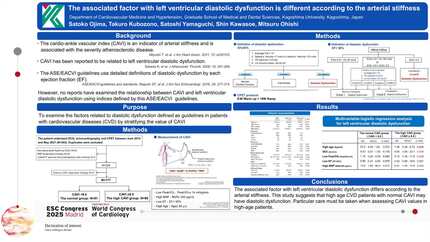
The associated factor with left ventricular diastolic dysfunction is different according to the arterial stiffness
European Heart Journal


Abstract
Cardio-ankle vascular index (CAVI) is an indicator of arterial stiffness, and this index has reported an association with atherosclerotic diseases. Furthermore, CAVI has been reported to be related to left ventricular diastolic dysfunction. Although left ventricular diastolic dysfunction has been evaluated using the E' wave, or E/A ratio until now, the ASE/EACVI guidelines use detailed definitions of diastolic dysfunction by each ejection fraction (EF). However, no reports have examined the relationship between CAVI and left ventricular diastolic dysfunction using indices defined by this ASE/EACVI guidelines.
To examine the factors related to diastolic dysfunction defined as guidelines in patients with cardiovascular diseases (CVD) by stratifying the value of CAVI
The study recruited 177 patients with CVD who underwent CAVI, echocardiography, blood sampling, and cardiopulmonary exercise testing (CPET). We divided into two groups according to the cut-off value of CAVI (CAVI< 8.0: the normal CAVI group, or CAVI≥ 8.0: the high CAVI group). All patients underwent 0W warm-up and 10W ramp on an upright electrical bicycle ergometer. We defined peak VO2< 14 ml/min/kg as low peak VO2. Low ejection fraction (EF) was defined as EF< 50%. High BNP level was defined as a BNP level> 200 pg/mL. Moreover, high age was defined as age≥ 65 years old. We performed a logistic regression analysis using the presence or absence of diastolic dysfunction as the dependent variable, and gender, low Peak VO2, low EF, high BNP level, and high age as explanatory variables.
Multivariable logistic regression analysis showed that in the normal CAVI group, high BNP level (OR 12.9, p=0.010) and high age (OR 23.2, p<0.001) were associated with diastolic dysfunction. On the other hand, in the high CAVI group, female (OR 5.50, p=0.010), low PeakVO2 (OR 4.12, p=0.029), and high BNP level (OR 4.51, p=0.030) were associated with diastolic dysfunction.
The associated factor with left ventricular diastolic dysfunction differs according to the arterial stiffness. This study suggests that high-age CVD patients with normal CAVI may have diastolic dysfunction. Particular care must be taken when assessing CAVI values in high-age patients.
Contributors

S Ojima
Author
Graduate School of Medical and Dental Sciences, Kagoshima University Kagoshima , Japan
T Kubozono
Author
S Yamaguchi
Author
S Kawasoe
Author
M Ohishi
Author
You may be interested in