Diastolic dysfunction as a predictor of postoperative heart failure in non-cardiac surgery
European Heart Journal


Abstract
Non-cardiac surgeries are increasing, necessitating better preoperative risk assessment. Cardiovascular complications remain a major cause of postoperative morbidity and mortality. While systolic function is a known predictor, diastolic dysfunction may also impact outcomes but is not included in risk models.
To evaluate the association between echocardiographic diastolic dysfunction and postoperative heart failure in non-cardiac surgery patients.
This retrospective study analyzed adults who had non-cardiac surgery at our Medical Center (2011–2023) with preoperative echocardiograms. Severe valve disease cases were excluded. Diastolic dysfunction was classified into normal left sided filling pressure (grade 0–1) or elevated filling pressure (grade 2–3). The primary outcome was postoperative heart failure or mortality. Secondary outcomes included in-hospital mortality, pulmonary edema, diuretic and vasoactive drug use, and hospital stay length.
Among 3,882 patients (mean age 69, 47% female), 44.9% had grade 0, 33.3% grade 1, 18.6% grade 2, and 3.1% grade 3 dysfunction.
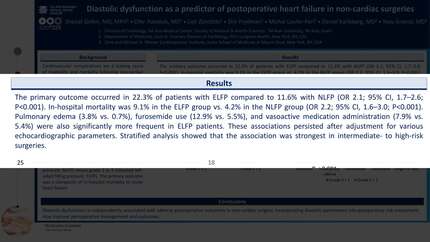
Primary outcome occurred in 13.9% overall, higher in the elevated filling pressure group (22.3%) vs. normal filling pressure group (11.6%, OR 2.1, 95% CI 1.7–2.6, P < 0.001). In-hospital mortality was also higher (9.1% vs. 4.2%, OR 2.2, P < 0.001). Pulmonary edema (3.8% vs. 0.7%, OR 4.9, P < 0.001). Diuretic use (12.9% vs. 5.5%, OR 2.5, P < 0.001) and vasoactive drug use (7.9% vs. 5.4%, OR 1.5, P = 0.007) were also higher in the elevated filling pressure group, which also showed a longer hospital length of stay (15.4 vs. 12 days, P < 0.001).
Diastolic dysfunction predicts perioperative complications, including heart failure and mortality, in non-cardiac surgery. Incorporating diastolic function into risk models may improve outcomes by enhancing risk stratification and guiding perioperative management. Further prospective studies are needed to determine whether targeted interventions in high-risk patients could reduce complications and improve long-term recovery.

You may be interested in