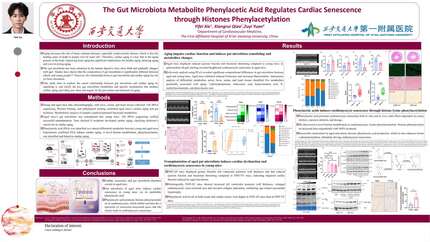
The gut microbiota metabolite phenylacetic acid regulates cardiac senescence through phenylacetylation modification of histones
European Heart Journal


Abstract
Aging elevates cardiovascular disease risk, potentially linked to gut microbiota dysbiosis, with distinct compositional differences observed between elderly and younger populations. This study aimed to identify critical bacterial taxa and metabolites driving age-related cardiac dysfunction and to delineate the gut microbiota/phenylacetic acid (PAA)/histone phenylacetylation/heart failure (HF) axis. Young and aged mice underwent reciprocal fecal microbiota transplantation (FMT) to assess cardiac aging phenotypes. Natural aging and FMT cohorts were analyzed via 16S rRNA sequencing, metabolomics, proteomics, and post-translational modification profiling to pinpoint PAA-associated mechanisms.
Aged mice exhibited gut microbiota dysregulation, characterized by reduced Bacteroidetes and elevated Firmicutes/Bacteroidetes ratios, alongside increased circulating PAA. PAA facilitated histone phenylacetylation, activating senescence-associated genes in cardiomyocytes, thereby promoting myocardial senescence and systolic dysfunction. Conversely, young microbiota transplantation restored microbial diversity, suppressed PAA levels, and attenuated histone modifications, improving cardiac function . Immunoblotting confirmed diminished histones phenylacetylation in young-FMT hearts.
These results unveil a novel pathway linking gut microbiota-derived PAA to epigenetic-driven cardiac aging and HF, proposing microbiota modulation or PAA inhibition as potential therapeutic strategies.


You may be interested in