Inferior vena cava measurements at rest and following the sniff test fail to correlate with right atrial pressure in heart failure: A multicenter study
European Heart Journal


Abstract
Assessment of the inferior vena cava (IVC) remains a key approach for evaluating and optimizing fluid status in various specialties, including cardiology.
To investigate IVC compliance at quiet respiration and during a sniff test as a surrogate for right atrial pressure (RAP) in patients with stage C heart failure, classified by ejection fraction (EF) into two groups: EF < 50% and EF ≥ 50%.
A prospective analysis was conducted on 325 patients from 11 centers. IVC diameters at quiet respiration and compliance during a sniff test were assessed using M-mode echocardiography through a subcostal window, 3.5 cm distal to the right atrium, with imaging perpendicular to the IVC. Compliance was calculated as the ratio of minimal to maximal IVC diameter, expressed as a percentage. Right heart catheterization was performed within 24 hours of echocardiography.
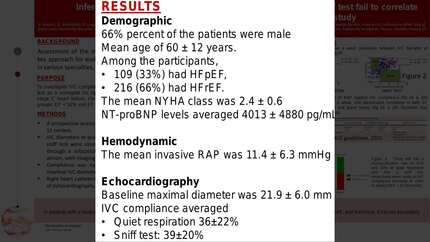
Sixty-six percent of the patients were male, with a mean age of 60 ± 12 years. Among the participants, 109 had HFpEF, while 216 (66%) had HFrEF. The mean NYHA class was 2.4 ± 0.6, and NT-proBNP levels averaged 4013 ± 4880 pg/mL. The mean invasive RAP was 11.4 ± 6.3 mmHg with a baseline maximal diameter of 21.9 ± 6.0 mm, while IVC compliance averaged 61 ± 21% . Both Fig 1A and 1B shows no correlation between IVC compliance and RAP. A scatter plot of RAP against IVC compliance (fig 1A & 1B) demonstrates a weak, and paradoxical correlation in both EF groups. Fade and green boxes (fig 1A & 1B) illustrates true positive patients while others dotplots had a misclassification rate of 92% and 88% at quiet respiration and after a sniff test, respectively when using an IVC compliance threshold of >40% to predict RAP < 8 mmHg.
In patients with a history of heart failure, regardless of EF, IVC compliance measured during a sniff test is not a reliable surrogate for RAP, and therefore, it cannot accurately estimate right ventricular preload.
Contributors

E Berthelot
Author
D Logeart
Author
T Damy
Author
J C Eicher
Author
J N Trochu
Author
N Lamblin
Author
You may be interested in