Non-invasive artificial intelligence-enabled quantification of left ventricular end-systolic pressure
European Heart Journal


Abstract
Invasive left ventricular (LV) pressure-volume (PV) loops are considered the gold standard method to quantify LV physiology. Non-invasive methods to perform LV-PVLs have gained popularity and shown to be prognostic in heart failure. The most popular non-invasive measurement of ventriculo-arterial coupling (Ees/Ea), estimates LV end systolic pressure (ESP) using brachial cuff blood pressure (BP) measurements [1]. However, this method does not account for key factors which may affect the pressure waveform as it travels from the LV to the brachial artery; notably the stiffness of arterial segment between the LV and brachial artery, which naturally increases with ageing.
To train an artificial-intelligence (AI) model to predict invasive LVESP from brachial BPs and other key haemodynamic parameters including carotid-femoral pulse wave velocity (PWV) – the gold-standard non-invasive measure of arterial stiffness – and compare it to commonly used estimates of LVESP: Systolic BP (SBP) x 0.9 (LVESP[SBP]) and 2/3 SBP + 1/3 diastolic BP (DBP) (LVESP[SBP+DBP]).
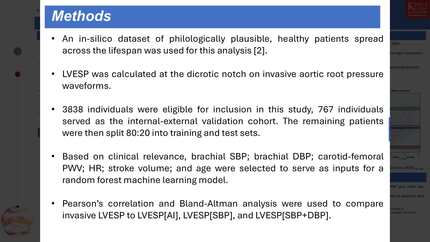
An in-silico dataset of philologically plausible, healthy patients spread across the lifespan was used for this analysis [2]. LVESP was calculated at the dicrotic notch on invasive aortic root pressure waveforms. 3838 individuals were eligible for inclusion in this study, 767 individuals served as the internal-external validation cohort. The remaining patients were then split 80:20 into training and test sets. Based on clinical relevance, brachial SBP; brachial DBP; PWV; HR; stroke volume; and age were selected to serve as inputs for a random forest machine learning model. Subsequently, the model was used to predict LVESP (LVESP[AI]) in the validation cohort. Finally, Pearson’s correlation and Bland-Altman analysis were used to compare invasive LVESP to LVESP[AI], LVESP[SBP], and LVESP[SBP+DBP].
The best performing model included SBP, DBP, HR, age, and PWV and could reliably predict LVESP (Root mean square error: 1.206). Notably, the coefficients for SBP (0.679) and DBP (0.327) were strikingly close to commonly used estimates. LVESP[AI] had a stronger correlation (R=0.994) with the invasive LVESP compared to the LVESP[SBP] (R=0.909) and LVESP[SBP+DBP] (R=0.908). Bland-Altman analysis showed LVESP[SBP] (Bias: -4.01 mmHg, p<0.001) and LVESP[SBP+DBP] (Bias: -0.91 mmHg, p<0.001) were significantly biased, and over-estimated true LVESP. LVESP[AI] displayed no significant bias (p=0.95).
Our novel, non-invasive, artificial-intelligence enabled quantification of LVESP has demonstrated that incorporating PWV and other key haemodynamic parameters alongside brachial BPs yields more representative and less-biased predictions of invasive LVESP. This builds upon existing methods enabling non-invasive pressure-volume loop characterisation of the LV, which can be used in research and clinical practice. Correlation plots and histograms Picture 2: Bland-Altman plots
Contributors

You may be interested in