Temporal trend of hemodynamic functional indices in isolated PVAD and combined therapy with VA-ECMO
European Heart Journal


Abstract
Continuous monitoring of hemodynamic functional indices during mechanical circulatory support (MCS) therapy may provide a better understanding of systemic flow and cardiovascular loadings in cardiogenic shock.
This study aims to describe the temporal trends of hemodynamic functional indices in patients receiving isolated percutaneous ventricular assist device (PVAD) or combination therapy with extracorporeal membrane oxygenation (VA-ECMO) (i.e. ECPELLA) in the UNLOADERS-PVAD registry, a Japanese multicenter registry with an extensive collection of longitudinal hemodynamic indices using invasive monitoring in patients using PVAD.
Using mixed effect models with random intercept and slope, cardiac output (CO) and pulmonary artery pulsatility index (PAPi) were analyzed from before, immediately after, and 24 hours after PVAD initiation to immediately before MCS termination. Similarly, cardiac power output (CPO) was described from before, 24 hours after PVAD initiation to immediately before MCS termination. Temporal trends were described in the survivors and the deceased during hospitalization in patients with isolated PVAD therapy and ECPELA therapy with VA-ECMO termination followed by PVAD termination. Of note, pressures and CO used to estimate the hemodynamic functional indices were measured using a pulmonary artery catheter. The observation time points for CPO were dependent on the availability of blood pressure measurements.
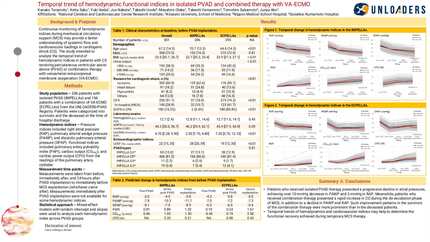
Among 206 patients (mean age 70 years, 74% male) who received isolated PVAD therapy, 46 (22.3%) died during the hospitalization. CO and CPO were consistently higher in the survivors of the isolated PVAD therapy (predicted marginal means above 3.0 L/kg/min and 0.5 W, respectively) than in those who died during the hospitalization (Figure 1). PAPi was similar between the survivors and the deceased throughout the isolated PVAD therapy. In 194 patients (mean age 64 years, 73% male) who received ECPELLA therapy, 96 (49%) died during hospitalization. The differences in CO and CPO during the initial phases of MCS therapy were subtle between the survivors and the deceased (Figure 2). Meanwhile, CO and CPO rapidly improved from 24 hours after PVAD initiation to VA-ECMO and PVAD termination in the survivors (Figure 2). The temporal trend of PAPi in patients with ECPELLA therapy appeared to have marginal differences between the survivors and the deceased.
A higher CO and CPO at any given time during MCS therapy appears to ensure better outcomes in patients with isolated PVAD therapy. The differences in such indices were compelling moments before MCS termination in patients with ECPELLA therapy. Continuous monitoring of hemodynamic functional indices in ECPELLA therapy may be clinically useful during the MCS weaning process.
Contributors

K Saku
Author
Y Ikeda
Author
J Nakata
Author
T Unoki
Author
M Otake
Author
T Yamamoto
Author
T Sakamoto
Author
J Ako
Author
You may be interested in