Integrating cardio-oncology in Multiple Myeloma: risk stratification and management of therapy-related cardiovascular toxicity
European Heart Journal


Abstract
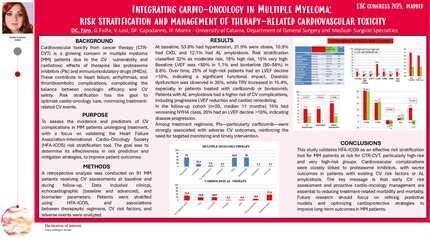
Cardiovascular toxicity from cancer therapy (CTR-CVT) is a growing concern in multiple myeloma (MM) patients due to their cardiovascular (CV) vulnerability and the cardiotoxic effects of therapies like proteasome inhibitors (PIs) and immunomodulatory drugs (IMiDs). These agents contribute to heart failure, arrhythmias, and thromboembolic complications, complicating the balance between oncologic efficacy and cardiovascular safety. Risk stratification toolsare critical for optimizing cardio-oncology care and minimizing treatment-related CV events.
This study aimed to assess the incidence and predictors of CV complications in MM patients undergoing treatment, with a focus on validating the Heart Failure Association-International Cardio-Oncology Society (HFA-ICOS) risk stratification tool. The goal was to determine its effectiveness in risk prediction and mitigation strategies, improving patient outcomes.
A retrospective analysis was conducted on 91 MM patients receiving cardiovascular assessments at baseline and during follow-up. Data included clinical, echocardiographic, and biomarker parameters. Patients were stratified using HFA-ICOS, and associations between therapeutic regimens, CV risk factors, and adverse events were analyzed.
At baseline, 53.8% had hypertension, 31.9% were obese, 10.9% had chronic kidney disease (CKD), and 12.1% had AL amyloidosis. Risk stratification classified 32% as moderate risk, 18% as high risk, 15% as very high risk. Baseline left ventricular ejection fraction (LVEF) was <50% in 1.1% and borderline (50–54%) in 8.8%. Over time, 25% of high-risk patients had an LVEF decline >10%, indicating a significant functional impact. Diastolic dysfunction was observed in 35%, while tricuspid regurgitation velocity (TRV) increased in 15.4%, especially in patients treated with carfilzomib or bortezomib. Patients with AL amyloidosis had a higher risk of CV complications, including progressive LVEF reductions and cardiac remodeling. In the follow-up cohort (n=20, median 11 months) 15% had worsening NYHA class, 20% had an LVEF decline >10%, highlighting disease progression. Among treatment regimens, proteasome inhibitors—particularly carfilzomib—were strongly associated with adverse CV outcomes, reinforcing the need for targeted monitoring and timely intervention.
This study validates HFA-ICOS as an effective risk stratification tool for MM patients at risk for CTR-CVT, particularly high-risk and very high-risk groups. Cardiovascular complications were closely linked to proteasome inhibitors, with worse outcomes in patients with existing CV risk factors or AL amyloidosis. The key message is that early CV risk assessment and proactive cardio-oncology management are essential to reducing treatment-related morbidity and mortality. Future research should focus on refining predictive models and optimizing cardioprotective strategies to improve long-term outcomes in MM patients. Oncologic and Cardiology Therapy Characteristics according to risk class
Contributors


You may be interested in