Cardiovascular adverse events associated with VEGFR 2-targeted inhibitor in patients with solid tumors: a meta-analysis of randomized controlled trials
European Heart Journal


Abstract
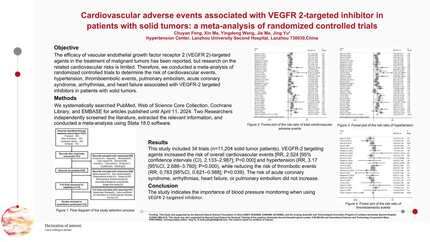
The efficacy of vascular endothelial growth factor receptor 2 (VEGFR 2)-targeted agents in the treatment of malignant tumors has been reported, but research on the related cardiovascular risks is limited. Therefore, we conducted a meta-analysis of randomized controlled trials to determine the risk of cardiovascular events, hypertension, thromboembolic events, pulmonary embolism, acute coronary syndrome, arrhythmias, and heart failure associated with VEGFR-2 targeted inhibitors in patients with solid tumors. We systematically searched PubMed, Web of Science Core Collection, Cochrane Library, and EMBASE for articles published until April 11, 2024. This study included 34 trials (n=11204 solid tumor patients). VEGFR-2 targeting agents increased the risk of overall cardiovascular events [relative ratios (RR), 2.524 [95% confidence intervals (CI), 2.133–2.987]; P=0.000] and hypertension (RR, 3.17 [95%CI, 2.686–3.760]; P=0.000), while reducing the risk of thrombotic events (RR, 0.783 [95%CI, 0.621–0.988]; P=0.039). The risk of acute coronary syndrome (RR, 1.015 [95%CI, 0.568–1.814]; P=0.959), arrhythmias (RR, 1.155 [95%CI, 0.826–1.615]; P=0.399), heart failure (RR, 1.641 [95%CI, 0.816–3.302]; P=0.165), or pulmonary embolism (RR, 0.786 [95%CI, 0.542–1.138]; P=0.201) did not increased. VEGFR 2-targeted agents can significantly increase the risk of total cardiovascular adverse events and hypertension. The risk of thromboembolic events associated with these drugs was significantly reduced, while the risk of heart failure, acute coronary syndrome, arrhythmia, and pulmonary embolism did not increase significantly. The study indicates the importance of blood pressure monitoring when using such drugs.