Efficacy of glucagon-like peptide-1 receptor agonists in patients with type 2 diabetes mellitus and chronic kidney disease
European Heart Journal


Abstract
The interplay between obesity, type 2 diabetes mellitus (T2DM), and chronic kidney disease (CKD) accelerates the decline in renal and cardiac function, a condition known as cardiometabolic kidney syndrome. Glucagon-like peptide-1 receptor agonists (GLP-1RAs) may mitigate this risk by targeting obesity and T2DM, but their efficacy in this population remains unclear.
This study aims to evaluate the efficacy ofGLP-1RAs in patients with T2DM and CKD.
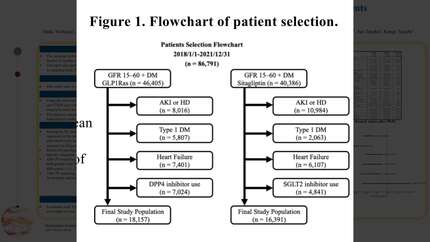
Using the real-world global electronic health record database, individuals with CKD (eGFR 15-60 mL/min/1.73 m²) and T2DM and without a history of HF who initiated GLP1RAs were compared to individuals who initiated sitagliptin from 2018 to 2021. The primary endpoint was a composite of all-cause mortality, new-incidence of HF, eGFR < 15 mL/min/1.73 m² or hemodialysis within three years. Propensity-score (PS) matching was used to adjust for baseline characteristics.
A total of 16,174 individuals starting GLP-1RAs and 14,613 starting sitagliptin were included in the analysis. After PS matching, 7,729 individuals were matched in each group. GLP1RAs was associated with a lower incidence of the composite endpoint, death and eGFR < 15 mL/min/1.73 m² (Figure). These findings were similar regardless of the baseline eGFR, microalbuminuria or the use of sodium glucose cotransporter-2 inhibitors.
In patients with T2DM and CKD, GLP-1RAs was associated with a lower risk of death and worsening of renal function compared to sitagliptin. The effect of GLP-1RAs

You may be interested in