Proteomic profiling of circulating exosome identifies CAPG as a key molecule associated with clinical outcomes in heart failure
European Heart Journal


Abstract
Exosomes are extracellular vesicles that facilitate the transport of bioactive molecules including proteins. Growing evidence suggests that exosomes play crucial roles in intercellular and interorgan communications under both physiological and pathological conditions. However, the proteomic composition or clinical relevance of the circulating exosome in heart failure (HF) has yet to be elucidated.
This study aimed to characterize the distinct proteomic profile of circulating exosomes in HF and to identify the prognostic significance of the exosomal molecules.
Circulating exosomes were isolated and purified from patient serum using size-exclusion chromatography. Quantitative proteomic analysis of the serum exosomes was conducted through mass spectrometry on samples from 15 patients with HF with reduced ejection fraction (HFrEF) and 8 non-HF control subjects in a discovery cohort. Associations between the exosomal molecules and clinical outcomes were examined in a validation cohort of 95 consecutively hospitalized HFrEF patients with idiopathic dilated cardiomyopathy (mean age, 57.4 years: 68.4% male).
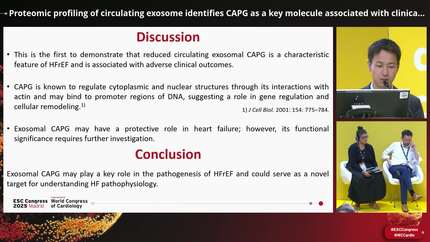
In the discovery cohort, quantitative proteomic analysis of circulating exosomes identified a total of 522 exosomal proteins, among which 19 molecules were significantly down-regulated and 6 were up-regulated in patients with HFrEF compared to controls (Figure 1). Notably, macrophage-capping protein (CAPG) emerged as one of the most down-regulated exosomal molecules in HFrEF. CAPG is known to regulate cytoplasmic and nuclear structures through potential interactions with actin and may bind to promoter regions of DNA, suggesting a role in gene regulation and cellular remodeling. In a validation cohort, patients were stratified into low exosomal CAPG (n = 48) and high exosomal CAPG (n = 47) groups. Those in the low exosomal CAPG group exhibited significantly higher B-type natriuretic peptide levels (P < 0.01) and larger left ventricular end-diastolic dimension (P < 0.01). To determine the prognostic impact of exosomal CAPG, follow-up assessments were conducted over a median follow-up period of 1313 days. Patients with decreased exosomal CAPG levels had lower event-free survival from the composite event of cardiac death and worsening heart failure (log-rank, P = 0.01, Figure 2). In a multivariable Cox proportional hazard model, low exosomal CAPG level was independently associated with increased risks of the composite of cardiac events with a hazard ratio of 3.07 (95% confidence interval, 1.01-7.36; P = 0.04).
Reduced circulating exosome CAPG is a characteristic feature of HFrEF and is associated with adverse clinical outcomes. Our findings suggest that exosomal CAPG plays a key role in the pathogenesis of HFrEF and could serve as a novel target for understanding HF pathophysiology and developing therapeutic strategies.
Contributors

A Yoshihisa
Author
Y Takeishi
Author
T Misaka
Author
R Ogawara
Author
S Ichimura
Author
T Yokokawa
Author
T Sato
Author
M Oikawa
Author
A Kobayashi
Author
You may be interested in