Humoral protein signature linked to circulating cell-free DNA in individuals with symptomatic heart failure
European Heart Journal


Abstract
Previous analyses demonstrated an increase in circulating cell-free DNA (cfDNA) concentration across the heart failure (HF) spectrum. This study aimed to investigate cfDNA-related molecular mechanisms in symptomatic HF.
CfDNA concentrations and plasma protein levels from blood samples of symptomatic HF participants in the MyoVasc cohort were analyzed. Elastic net-regularized regression with leave-one-out cross-validation (CV) identified cfDNA-related proteins. Multivariable linear regressions were used to evaluate associations between the protein signature of cfDNA and cardiac measurements (echocardiography, Holter ECG, cardiopulmonary exercise testing) and cardiovascular risk factors (CVRFs). Worsening of HF (WoHF) was defined within 4 years of follow-up as the composite of HF-related hospitalizations or cardiac death. The prognostic value of cfDNA-protein signature for WoHF was assessed using Cox regression. Molecular functions of cfDNA-related proteins were explored by Reactome, KEGG and Gene Ontology terms.
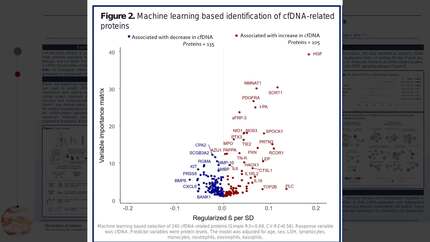
Symptomatic HF participants [N=1,630; mean age (SD): 67.7(9.9); 33.1% female] were analyzed. The most prevalent CVRFs were arterial hypertension (82.4%) and dyslipidemia (80.1%), while predominant comorbidities were coronary artery disease (52.4%), myocardial infarction (35.3%), and atrial fibrillation (33.6%). Out of 538 proteins, 240 were identified as linked to cfDNA (CV-R2=0.56). Among them, 105 proteins (top three: HGF, SORT1, and NMNAT1) were associated with an increase and 135 proteins (top three: CPA2, SCGB3A2, and MMP-10) with a decrease in cfDNA concentrations. The cfDNA protein signature showed strong association with cardiac measurements, including left ventricular (LV) mass index (β=0.11[0.06; 0.16], p<0.0001), LV E/E’ ratio (β=0.14[0.09; 0.19], p<0.0001), global longitudinal strain (β=0.10[0.04; 0.16], p=0.002), LV ejection fraction (β=-0.12[-0.17; -0.07], p<0.0001), as well as cardiac autonomic imbalance based on the Poincare plot SD1/SD2 (β=0.17[0.10; 0.25], p<0.0001) and heart rate recovery (β=-0.13[-0.20; -0.06], p=0.0001). The signature was a strong predictor of WoHF over 4 years (Hazard Ratio=1.42[1.31; 1.53], p< 0.0001). Obesity (β=0.38[0.28; 0.48], p<0.0001), diabetes mellitus (β=0.17[0.06; 0.27], p=0.0023) and smoking (β=-0.30[-0.44; -0.16], p<0.0001) were related with the protein signature. Molecular functions of cfDNA-related proteins were linked to cytokine and chemokine activity (e.g. IL-1, CCLs, and CXCLs), matrix metalloproteinases activity, neutrophil degranulation, TGF-beta and JAK-STAT signalling pathway.
The findings showed an interplay between circulating cfDNA and specific proteins, suggesting a role of immune and inflammatory regulation in symptomatic HF. These insights contribute to a better understanding of mechanisms leading to circulating cfDNA in HF and might highlight candidate biomarkers for monitoring and therapeutic targeting.
Contributors

V Ten Cate
Author
A Gieswinkel
Author
M Krolevets
Author
S Zeid
Author
T Gori
Author
L Lurz
Author
E Neuberger
Author
P Simon
Author
P Wild
Author
You may be interested in