The effect of CTI anatomical features and catheter displacement on re-conduction after Cavotricuspid Isthmus linear ablation
European Heart Journal


Abstract
Cavotricuspid isthmus (CTI) linear ablation is the standard treatment for common atrial flutter (AFL). However, there have been only a few reports investigating predictors of re-conduction of CTI block line during long-term follow-up.
We aimed to examine whether anatomical features assessed by pre-procedural CT scans and catheter displacement during the initial CTI linear ablation were associated with re-conduction of CTI block line.
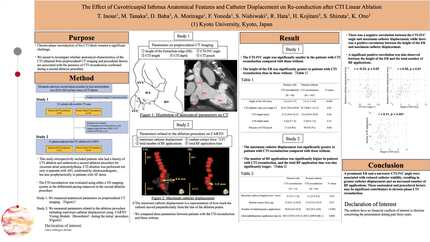
This study included 211 cases who underwent CTI linear ablation, and subsequently underwent re-ablation for atrial tachyarrhythmia between January 2018 and December 2022. We evaluated re-conduction of CTI block line by using mapping system or differential pacing in re-ablation session. We measured CTI length, depth, angle, presence and height of an Eustachian ridge (ridge), and presence of a pouch on CT scans (Figure1). Additionally, in 71 cases performed with CARTOR in the initial CTI linear ablation session, we measured the maximum lateral displacement of an ablation catheter during RF delivery using CARTOR VISITAG Module. We compared these measurements of CT scans and Mapping between the re-conduction group and the non-re-conduction group. Furthermore, we examined the correlation between maximum displacement and CT-measured anatomical features.
In 211 cases with available CT scans, Re-conduction of the CTI block line were observed in 48 cases . There was no significant difference in the CTI length (P=0.59), depth (P=0.37)or the presence of a pouch (P=0.42)between the two groups. However, in the re-conduction group, CTI angle was significantly smaller (91.6°±20.3°VS 98.8°±17.7°,P=0.018)and the rate of cases with a ridge were significantly higher (58%/42% VS 40%/60%, P=0.013).
In 71 cases using CARTO system, re-conduction of the CTI block line was observed in 21 cases. Maximum displacement was significantly larger in the re-conduction group (6.7mm±2.2mm VS 5.2mm±2.8mm, P=0.03). (Figure2) Furthermore, In the two groups (smaller angle group and larger angle group devided by median angle), maximum displacement was significantly larger (6.1mm±2.4mm VS 4.7mm±1.4mm, P=0.01) in the smaller angle group. In the two groups based on the presence or absence of a ridge, maximum displacement was significantly larger in the ridge group (6.0mm±2.1mm VS 4.7mm±1.9mm ,P=0.03).
This study revealed that a smaller CTI angle, the presence of a ridge, and a larger maximum displacement of the ablation catheter may be associated with re-conduction of CTI blockline . Also, This study suggested that catheter displacement during ablation may result from the anatomical characteristics of the CTI and influence re-conduction of CTI block line. CTI anatomical features on CT scans Representative cases
Contributors

M Tanaka
Author
D Baba
Author
A Morinaga
Author
F Yoneda
Author
S Nishiwaki
Author
R Hata
Author
H Kojitani
Author
S Shizuta
Author
K Ono
Author
You may be interested in