Differential effect of low-voltage area ablation on atrial tachycardia recurrence in diabetic versus non-diabetic patients with persistent atrial fibrillation: sub-analysis of the SUPPRESS-AF Trial
European Heart Journal


Abstract
Low-voltage area (LVA) ablation following pulmonary vein isolation (PVI) has shown potentially improved outcomes in persistent atrial fibrillation (AF) but may increase atrial tachycardia (AT) recurrence. This study investigates how LVA ablation affects arrhythmia recurrence patterns with specific focus on diabetic status.
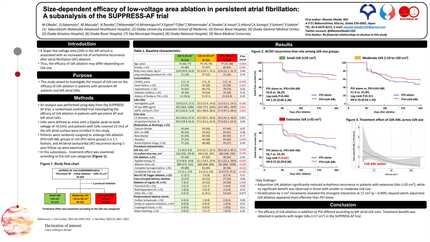
This study is a subanalysis of the SUPPRESS-AF trial (Ref 1) including patients with persistent AF undergoing initial catheter ablation procedure. After PVI, those with significant LVAs (bipolar voltage <0.5mV covering ≥5 cm² of left atrial surface) were randomized 1:1 to either additional LVA ablation (PVI+LVA group) or no further ablation (PVI-alone group). The primary endpoint was 1-year freedom from AF/AT recurrence without antiarrhythmic drugs. Recurrences were classified by arrhythmia type (AF or AT) and analyzed according to diabetes status and ablation strategy.
Of 1,347 persistent AF patients, 343 (25.5%) had significant LVAs and were randomized: 265 non-diabetic (137 PVI-alone, 128 PVI+LVA) and 77 diabetic patients (35 PVI-alone, 42 PVI+LVA). As reported previously, PVI+LVA ablation showed numerically higher freedom from AF/AT recurrence than PVI-alone (61% [% [15%-34%] vs. 30% [24%-36%], p=0.316). Among the four treatment subgroups, AT recurrence rate was substantially higher in diabetic patients receiving PVI+LVA ablation (23.8%) compared to other groups (non-DM/PVI-alone: 7.3%, non-DM/PVI+LVA: 9.4%, DM/PVI-alone: 8.6%; p=0.035), whereas AF recurrence rate showed no significant difference across the same groups (non-DM/PVI-alone: 35.8%, non-DM/PVI+LVA: 23.4%, DM/PVI-alone: 25.7%, DM/PVI+LVA: 21.4%, p=0.106).
The increased incidence of AT recurrence following LVA ablation was observed predominantly in diabetic patients, suggesting diabetes-specific arrhythmogenic substrates may influence ablation outcomes. These findings highlight th95% CI, 53%-68%] vs. 50% [42%-57%]) in the overall population. AT as first recurrence was significantly more frequent in the PVI+LVA group compared to PVI-alone (36% [24%-49%] vs. 18% [10%-30%], p=0.029). When stratified by diabetic status, the proportion of AT as first recurrence was significantly higher in diabetic versus non-diabetic patients (42% [25%-61%] vs. 22% [14%-31%], p=0.036), while AF recurrence rates were similar (23e importance of considering diabetic status when planning LVA ablation strategies for persistent AF management.


You may be interested in