Predictors of hemodynamic and respiratory instability during pulmonary vein isolation: findings from a retrospective cohort
European Heart Journal


Abstract
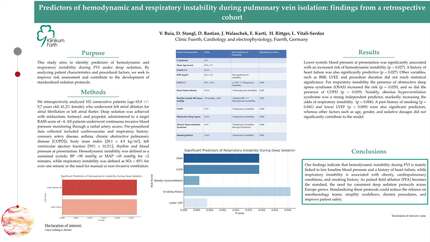
Deep sedation is increasingly used in pulmonary vein isolation (PVI) for atrial fibrillation and flutter, particularly with pulsed field ablation (PFA), which often requires deeper sedation than traditional methods. However, sedation protocols vary across Europe, and there is no standardized approach, raising concerns about patient safety.
This study aims to identify predictors of hemodynamic and respiratory instability during PVI under deep sedation. By analyzing patient characteristics and procedural factors, we seek to improve risk assessment and contribute to the development of standardized sedation protocols.
We retrospectively analyzed 102 consecutive patients (age 65,8 +/- 9,7 years old; 41,2% female), who underwent left atrial ablation for atrial fibrillation or left atrial flutter. Deep sedation was achieved with midazolam, fentanyl, and propofol, administered to a target RASS score of –4. All patients underwent continuous invasive blood pressure monitoring through a radial artery access. Pre-procedural data collected included cardiovascular and respiratory history: coronary artery disease, asthma, chronic obstructive pulmonary disease [COPD]), body mass index [28.1 ± 4.9 kg/m²], left ventricular ejection fraction [59% ± 10.2%], rhythm and blood pressure at presentation. Hemodynamic instability was defined as a sustained systolic BP <90 mmHg or MAP <65 mmHg for >2 minutes, while respiratory instability was defined as SO₂ < 85% for over one minute or the need for manual or non-invasive ventilation.
lower systolic blood pressure at presentation was significantly associated with an increased risk of hemodynamic instability (p = 0.027). A history of heart failure was also significantly predictive (p = 0.027). Other variables, such as BMI, LVEF, and procedure duration did not reach statistical significance. For respiratory instability the presence of obstructive sleep apnea syndrome (OSAS) increased the risk (p = 0.029), and so did the presence of COPD (p = 0.029). Notably, obesitas hyperventilation syndrome was a strong independent predictor, markedly increasing the odds of respiratory instability (p = 0.006). A past history of smoking (p = 0.041) and lower LVEF (p = 0.009) were also significant predictors, whereas other factors such as age, gender, and sedative dosages did not significantly contribute to the model.
Our findings indicate that hemodynamic instability during PVI is mainly linked to low baseline blood pressure and a history of heart failure, while respiratory instability is associated with obesity, cardiopulmonary conditions, and smoking history. As pulsed field ablation (PFA) becomes the standard, the need for consistent deep sedation protocols across Europe grows. Standardizing these protocols could reduce the reliance on anesthesiology teams, simplify workflows, shorten procedures, and improve patient safety. Risk factors respiratory instability Risk factors hemodynamic instability
Contributors

D Stangl
Author
D Bastian
Author
J Walaschek
Author
E Kurti
Author
H Rittger
Author
L Vitali-Serdoz
Author
You may be interested in