Repeat ablation for persistent AF: additional continuous complex activity mapping vs sole Re-PVI - Results of the randomized AF CAM study
European Heart Journal


Abstract
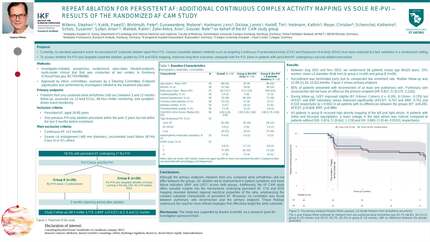
Currently, no standard approach exists for persistent AF substrate ablation. Several substrate ablation methods such as targeting Continuous Fractionated Activity (CFA) and Dispersion of Activity (DOA) are explored but often lack rigorous validation in randomized setting.
To assess whether Re-PVI plus targeted substrate ablation, guided by CFA and DOA mapping, improves long-term outcomes compared with Re-PVI alone in patients with persistent AF undergoing a second ablation procedure.
The AF CAM study is an investigator-initiated, prospective, randomized, open-label, blinded-endpoint, multi-center clinical trial. Patients with persistent AF (aged 18–85 years) undergoing a second ablation for AF recurrence were randomized 1:1 to either: Group A: Re-PVI alone or Group B: Re-PVI plus targeted ablation of areas scoring in the top 10% for CFA and/or DOA. 200 patients were planned to be randomized. Mapping was performed using high-resolution 8-spline multipolar basket catheter. Target areas were identified using custom algorithms that quantified CFA and DOA, with ablation performed until local electrogram amplitudes were reduced to <0.1 mV. The primary endpoint was freedom from any sustained atrial arrhythmia (>30 sec) between 3 and 12 months follow-up, assessed via 12-lead ECGs, 48-hour Holter monitoring, and symptom-driven event monitoring.
Between Aug 2021 and Nov 2023, we randomized 56 patients (mean age 68±10 years, 32% women, mean LA diameter 45±6 mm) to group A (n=28) and group B (n=28). Baseline characteristics and procedural data were comparable. The median procedure time was 87 [71, 110] minutes for group A and 161 [140, 218] minutes for group B. Recruitment was terminated early due to slow enrolment. Median follow-up was 12.09 [11.24, 12.62] months. The 1-year Kaplan-Meier estimate for freedom from any sustained atrial arrhythmia was 62.7% [46.8%, 84.1%] in group A (10 events) and 59.1% [42.3%, 82.4%] in group B (10 events), with no difference between the groups. 85% of patients presented with reconnection of at least one pulmonary vein. Pulmonary vein reconnection did not have an effect on the primary endpoint (HR 0.927, CI [0.275, 3.120]). Additionally, there was no correlation between pulmonary vein reconnection and the mapping parameters. Notably, all patients of group B underwent comprehensive high-density mapping of both the left and right atria, the results of which will be presented.
Although the primary endpoint defined as freedom from any sustained atrial arrhythmia did not differ between the groups, AF-CAM study gives valuable insight into mechanisms of persistent AF. CFA and DOA mapping provided detailed insights into the regional electrical properties of the atria, underscoring the complex substrate of persistent AF, independent of pulmonary vein reconnection. These findings highlight the need for refined strategies that target the atrial substrate more effectively. Primary endpoint analysis
Contributors

P Wohlmuth
Author
M Gunawardene
Author
J Dickow
Author
K Heitmann
Author
K Scherschel
Author
S Scholz
Author
A Sultan
Author
R Wahedi
Author
A Zahir-Akkra
Author
N Gessler
Author
You may be interested in