Patients with persistent atrial fibrillation with advanced left atrial remodeling have low levels of serum cardiac enzymes after cryoballoon ablation and are at higher risk of post-ablation recurrence
European Heart Journal


Abstract
Advances in medical technology have improved the durability of pulmonary vein isolation (PVI) by catheter ablation. As a result, an increasing number of cases have recurrent atrial fibrillation (AF) despite the absence of PV-left atrial (LA) electrical re-conduction.
To elucidate the mechanisms of AF recurrence by analyzing risk factors for recurrence after cryoballoon ablation (CBA) of persistent AF (PsAF) and electrophysiological findings in patients undergoing a second ablation.
Patients with PsAF who underwent CBA at our institution between September 2017 and February 2022 were included. Treatment consisted of PVI with a 28mm-CB and cavotricuspid isthmus (CTI) ablation with a radiofrequency catheter (RFC), additional right atrial-superior vena cava (SVC) isolation, and intra-LA treatment with RFC for treatment-resistant cases. Patients who remained in sinus rhythm without antiarrhythmic drugs (AADs) were included in the AF-suppressed group, and the remainder in the non-suppressed group. Age, sex, body mass index (BMI), left atrial diameter (LAD), and ejection fraction (EF) measured by echocardiography were selected as patient background, and total freezing time, creatine kinase-MB (CK-MB) and cardiac troponin T (cTnT) on the day after treatment were selected as treatment information. The risk of recurrence was statistically analyzed. In addition, the durability of PVI was assessed in all patients who underwent a second ablation.
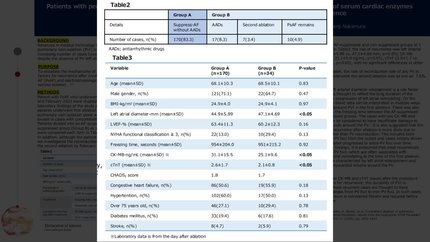
The total number of patients was 204, age 68.2±10.3years, sex: male 69.8%, BMI 24.9±4.1kg/m2, LAD and EF were 45.3±5.8mm and 62.9±11.5%, respectively. Ablation included 100% PVI, 87.3% CTI, 8.3% SVC isolation, and 0.5% LA block line creation. CB freezing time was 954±213seconds, CK-MB and cTnT were 30.23±14.9IU/L and 2.5±1.6ng/mL, respectively. After 1 year, 83.3% of the patients had suppressed AF without AADs, 8.3% with AADs, 3.4% had undergone a second ablation, and 4.9% remained in PsAF. At the end of the follow-up period (51.1±18.2months after the first ablation), 70.1% of the patients had AF suppressed by the first ablation alone, and 17.1% underwent a second ablation. Comparing the AF-suppressed and non-suppressed groups at 1 year, the risk of recurrence was LAD (44.9±5.89 vs. 47.1±4.69mm, p<0.02), CK-MB (31.1±15.52 vs. 25.1±9.61IU/L, p<0.01), cTnT (2.59±1.7 vs. 2.11±0.81ng/mL, p<0.01), with no significant differences in other parameters. Analysis of electrophysiological findings in 35 patients who underwent a second ablation by February 2025 (time from first to second ablation: 23±16.6months) showed a PV reconduction rate of 7.6%.
LA dilatation and low CK-MB and cTnT levels after the procedure were risk factors for recurrence; the durability of PVI is sufficient, and most recurrent cases are thought to have pathological changes from PV foci to non-PV foci. In such cases, peri-PV myocardium is considered fibrotic and reduced before the first ablation.
Contributors

T Akatsuka
Author
T Mori
Author
K Suzuki
Author
K Nakamura
Author
T Takamura
Author
K Tone
Author
K Maeno
Author
T Seko
Author
A Kasai
Author
You may be interested in