Reducing recurrence, enhancing success: the role of substrate modification in atrial fibrillation redo procedures
European Heart Journal


Abstract
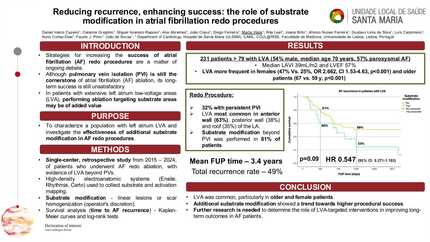
Strategies for increasing the success of atrial fibrillation (AF) redo procedures are a matter of ongoing debate. Although pulmonary vein isolation (PVI) remains the cornerstone of AF ablation, its long-term efficacy is unsatisfactory. In patients with extensive left atrium low-voltage areas (LVA), performing ablation targeting substrate areas may be of added value.
To characterize a population with left atrium LVA and investigate the effectiveness of additional substrate modification in AF redo procedures.
This retrospective, single-center study included patients who underwent AF redo ablation from 2015 to 2024, with evidence of left atrium LVA beyond PVs. High-density electroanatomic systems (Ensite, Rhythmia, Carto) were used to collect substrate and activation mapping. Substrate modification through linear lesions or scar homogenization was performed at the operator's discretion. Survival analysis with Kaplan-Meier curves and log-rank tests were used to evaluate the time to AF recurrence.
From a total of 231 patients who underwent AF redo ablation, 79 had evidence of LVA. Patients had a median age of 70 years (y), 54% were male, and 57% had paroxysmal AF. Most patients did not have structural heart disease, and the median left atrial (LA) indexed volume and left ventricular ejection fraction were 39 mL/m² and 57%, respectively. LVA was more frequent in females (47% vs. 25%, odds ratio 2.662, 95% confidence interval [CI]: 1.530-4.630, p<0.001) and older patients (67 vs. 59 y, p<0.001). In the redo procedure, 32% of patients had persistence of PVI. LVA was most commonly identified in the anterior wall (63%), followed by the posterior wall (38%) and roof (35%) of the LA. Substrate modification beyond PVI was performed in 64/79 patients (81%). During a mean follow-up time of 3.4 years, the recurrence rate of AF was 49%. Patients who underwent additional substrate modification had a longer time to AF recurrence, although it did not reach statistical significance (hazard ratio 0.547, 95% CI: 0.271-1.103, p=0.09).
In this population undergoing AF redo ablation, the presence of LVA was common, particularly in older and female patients. Performing additional substrate modification showed a trend towards higher procedural success, with a longer time to AF recurrence. Further research is needed to determine the role of LVA-targeted interventions in improving long-term outcomes in AF patients.
Contributors

C Gregorio
Author
M A Raposo
Author
A Abrantes
Author
R Leal
Author
J Cravo
Author
D Ferreira
Author
J Brito
Author
A N Ferreira
Author
G L Silva
Author
M Vilela
Author
L Carpinteiro
Author
N Cortez-Dias
Author
F J Pinto
Author
J De Sousa
Author
You may be interested in