Efficacy of vein of Marshall ethanol infusion for recurrent persistent atrial fibrillation in patients with durably isolated pulmonary veins
European Heart Journal


Abstract
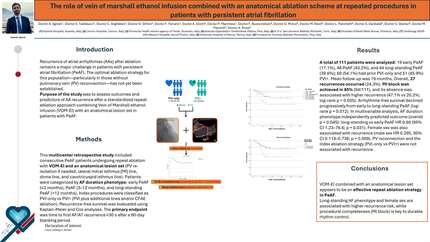
Vein of Marshall ethanol infusion (VoM-EI) has been shown to reduce atrial tachyarrhythmia recurrence in patients with persistent atrial fibrillation (AF) undergoing initial procedures. However, little is known about its benefit in patients with durably isolated pulmonary vein (PV) in repeat catheter ablation for persistent AF.
We aimed to determine whether adding VoM-EI to conventional catheter ablation during the repeat procedure could improve sinus rhythm maintenance.
Among 164 consecutive patients who underwent repeat catheter ablation for persistent AF, 56 with durably isolated PVs (67.1 ± 10.0 years, 43 males) were included in the analysis after excluding 67 patients with PV reconnection and 41 with a previous history of left atrial (LA) linear ablation. We compared the incidence of atrial tachyarrhythmia recurrence and complications between those with and without VoM-EI.
Twenty-four patients underwent radiofrequency (RF) ablation combined with VoM-EI (VoM-EI group), and 32 patients received RF ablation alone (control group). Baseline characteristics were not significantly different, except for the higher body mass index (26.6 ± 4.3 vs. 22.7 ± 2.8 kg/m2, p=0.0001) and larger LA diameter in the VoM-EI group (46.0 ± 5.0 vs. 41.8 ± 6.3 mm, p=0.008) compared to those in the control group. During the repeat procedure, mitral isthmus ablation was performed in all patients in the VoM-EI group, while only one patient (3.1%) underwent mitral isthmus ablation in the control group. LA posterior wall isolation, cavotricuspid isthmus ablation, superior vena cava isolation, and non-PV trigger ablation were performed in 50 (89.3 %), 34 (60. 7%), 26 (46.4%), and 12 (21.4%) patients, respectively. There were no significant differences in the incidence of additional procedures between the two groups. The procedure time was significantly longer in the VoM-EI group (249.3 ± 77.5 vs. 207.5 ± 63.4 minutes, p=0.03). During a mean follow-up of 499±315 days, the recurrence of atrial tachyarrhythmias was significantly reduced in the VoM-EI group (20.8 % in the VoM-EI group vs. 59.4 % in the control group) (log-rank, p=0.02) (Figure). There were three major complications (one cerebral infarction in the VoM-EI group, one cardiac tamponade, and one inferior vena cava injury in the control group); however, none of them were associated with VoM-EI.
In patients with recurrent persistent AF despite durable isolated PV, an ablation strategy incorporating VoM-EI increased the likelihood of remaining free from atrial tachyarrhythmias without increasing the complications. Patient population
Contributors

T Kamakura
Author
T Nakamura
Author
S Oka
Author
T Oshima
Author
A Wakamiya
Author
N Ueda
Author
K Nakajima
Author
M Wada
Author
K Ishibashi
Author
Y Inoue
Author
K Miyamoto
Author
T Aiba
Author
K Kusano
Author
You may be interested in