Predicting ablation difficulty for idiopathic ventricular premature contractions: the role of distance between earliest activation sites identified by near-field and first-deflection
European Heart Journal


Abstract
Catheter ablation is an effective treatment for ventricular premature contractions (VPCs), but complete elimination can be challenging, particularly when the origin is deep within the endocardium. Near-field (NF) annotation primarily captures endocardial signals, focusing on local VPC activation, whereas first-deflection (FD) annotation captures a broader range of signals, including those from deeper myocardial sites. We hypothesized that VPCs originating from deep sites may show discrepancies in the earliest activation site (EAS) between NF and FD annotations.
To investigate the relationship between the difficulty of VPC elimination and the spatial distance between the endocardial EASs identified using NF and FD annotations (NF-FD distance).
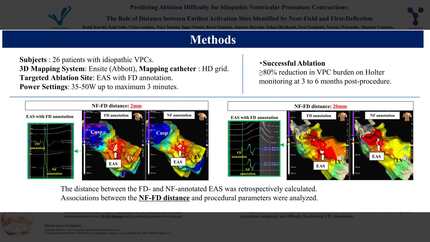
We retrospectively analyzed data from 26 patients (20 males; mean age: 58±11 years) who underwent catheter ablation for idiopathic VPCs. Ablation was targeted at the FD-identified EAS using power settings of 35–50 W for up to 3 minutes per site. Complete success was defined as the absence of VPCs post-ablation, while partial success was defined as a reduction in VPCs. Failure was defined as unchanged or increased VPCs after ablation. NF-FD distance was measured retrospectively (Figure 1).
Ablation was completely successful in 21 cases and partially successful in 5 cases. The successful ablation sites included the left ventricular outflow tract (LVOT; n=13), right ventricular outflow tract (RVOT; n=9), and other sites (n=4). The mean NF-FD distance was 8.3±8.0 mm. The mean number of ablation points, total ablation duration, and total energy delivered were 11.8±8.0 points, 739±509 seconds, and 25,615±18,618 J, respectively. The NF-FD distance moderately correlated with the number of ablation points (R=0.664, p<0.001), strongly correlated with total ablation duration (R=0.789, p<0.001), and strongly correlated with total energy delivered (R=0.816, p<0.001) (Figure 2).
Discrepancies between the endocardial EASs identified by NF and FD annotations may reflect greater procedural complexity and difficulty in achieving VPC elimination.
Contributors

K Sudo
Author
C Asahina
Author
Y Tanaka
Author
I Omori
Author
R Yamada
Author
J Deyama
Author
T Yoshizaki
Author
U Manabu
Author
T Kobayashi
Author
K Nakamura
Author
You may be interested in