Radiofrequency catheter ablation is associated with reduced cardiovascular events in atrial fibrillation patients with mitral regurgitation
European Heart Journal


Abstract
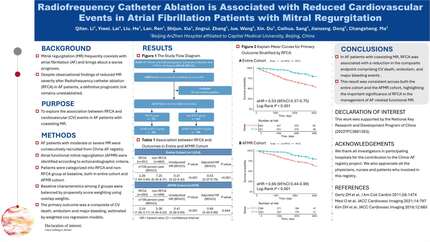
Mitral regurgitation (MR) frequently coexists with atrial fibrillation (AF) in clinical practice and carries a worse prognosis. Radiofrequency catheter ablation (RFCA) was proved to be an effective rhythm control method, but whether it improves prognosis in such patients remains controversial.
The purpose of this study was to evaluate the association between RFCA and cardiovascular events rate in AF patients with coexisting MR.
In this prospective observational study, AF patients with moderate or severe MR were consecutively recruited from China-AF registry and were categorized into RFCA and non-RFCA group at baseline. Baseline characteristics among 2 groups were balanced using propensity overlap weighting methods. The primary outcome was a composite of cardiovascular death, embolism and major bleeding, estimated by multivariable Cox regression analysis.
A total of 1,014 patients (51.8% female; mean age 68.83 years; 75.4% moderate MR, 8.4% moderate-severe MR and 16.2% severe MR; 60.0% persistent AF) were included in this analysis. Patients in RFCA group was younger and had less persistent AF (52.7% [n=185] vs. 63.8% [n=423]; P<0.001), a smaller mean (SD) left atrial diameter (43.62 [5.20] mm vs. 46.92 [7.69] mm; P<0.001), and higher mean (SD) left ventricular ejection fraction (58.81 [10.23] % vs. 55.24 [11.96] %; P<0.001). The difference in MR degree between two groups was not statistically significant. During a median follow-up of 1857 days (IQR, 695-2,556 days), 249 patients experienced the primary outcome. Patients in RFCA group had lower rate of composite events (12.3% vs. 31.1%, adjusted hazard ratio [aHR]: 0.53 [95% CI: 0.37-0.75]; P<0.001), all-cause mortality (8.8% vs. 35.4%, aHR: 0.45 [95% CI: 0.31-0.67]; P<0.001) and cardiovascular death (4.6% vs. 22.8%, aHR: 0.38 [95% CI: 0.22-0.64]; P<0.001) compared with those in non-RFCA group.
This study suggested that in AF patients with coexisting MR, RFCA was associated with lower rates of cardiovascular events, which might be considered as a prioritized therapeutic option among those patients in clinical practice. Kaplan-Meier Curve Analyses
Contributors

Q I F A N Li
Author
Beijing AnZhen Hospital affiliated to Capital Medical University Beijing , China
Y I W E I Lai
Author
Beijing AnZhen Hospital affiliated to Capital Medical University Beijing , China
S H I J U N Xia
Author

J I A N Z E Dong
Author
You may be interested in