Intravascular hemolysis and acute kidney injury in pulsed field versus radiofrequency ablation: a systematic review and meta-analysis
European Heart Journal


Abstract
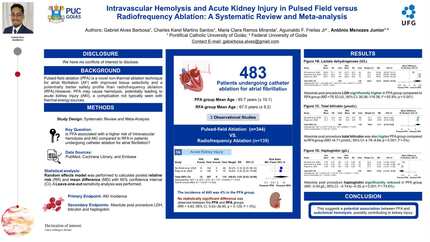
Pulsed-field Ablation (PFA) has emerged as a potentially safer alternative to Radiofrequency Ablation (RFA) due to minimal reports of injuries to non-cardiac tissues. However, recent studies suggest that PFA may lead to hemolysis (HM), which could contribute to the development of acute kidney injury (AKI).
This study aims to evaluate the possible correlation between PFA and AKI through an analysis of AKI incidence and biomarkers associated with HM.
PubMed, Embase, and Cochrane databases were systematically searched for randomized clinical trials (RCTs) and non-RCTs comparing PFA with RFA that included values of biomarkers of HM and a register of AKI occurrences. A random-effects model was used to calculate mean difference (MD) or Relative Risk (RR) with 95% confidence interval (CI). Substantial heterogeneity was defined as I2 > 50%. Analysis was conducted in R software.
Three studies enrolling 483 patients were included, with 344 in the PFA group. Although AKI was reported exclusively in the PFA group, with a prevalence of 4%, no statistical significance was observed (RR 4.96; 95% CI 0.64-38.66; p = 0.126; I² = 0%; Figure 1A). In the analysis of the biomarkers of HM, Lactate Dehydrogenase (LDH) was significantly higher in the PFA group post ablation (MD +78.52 U/L; 95% CI 38.68-118.36; p < 0.001; I² = 93.9%; Figure 1B), as was total bilirubin (MD +6.71 µmol/L; 95% CI 4.78-8.64; p < 0.001; I² =0%; Figure 1C). On the other hand, our analysis showed significant reduced levels of haptoglobin (MD −0.54 g/L; 95% CI −0.74, −0.35; p < 0.001; I² =74.6%; Figure 1D). High heterogeneity was observed in both haptoglobin and LDH analysis, which may be due to the them not being RCTs. This prompted us to perform a leave-one-out sensitivity analysis and, when omitting De Smet et al. 2024, no heterogeneity was observed in LDH while maintaining statistical significance (p < 0.001; I² =0%; Figure 2A), and the same was observed when omitting Osmarick et al. 2024 in the haptoglobin analysis (p < 0.001; I² =0%; Figure 2B).
While no statistically significant difference in AKI recurrence was observed, possibly due to the limited sample size, biomarker analysis strongly suggests an association between PFA and HM. These findings underscore the need for large-scale randomized trials. Forest Plots for AKI and hemolysis Forest plots of leave-one-out analysis
Contributors



You may be interested in