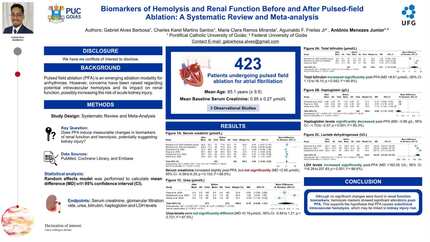
Comparison of pre- and post-procedure biomarkers of intravascular hemolysis and renal function in patients undergoing pulsed field ablation: a systematic review and meta-analysis
European Heart Journal


Abstract
Recently, reports have raised concerns about whether pulsed-field ablation (PFA) may impair renal function due to hemolysis following the procedure. This concern arises from the release of hemoglobin and free heme, which could cause oxidative cell damage and potentially increase the risk of acute kidney injury.
This study aims to evaluate potential kidney injury by analyzing changes in renal function biomarkers and hemolysis biomarkers before and after PFA.
PubMed, Embase, and Cochrane databases were systematically searched for randomized clinical trials (RCTs) and non-RCTs that included values of biomarkers of renal function and HM. A random-effects model was performed to calculate mean difference (MD with 95% confidence interval (CI). Substantial heterogeneity was defined as I2 > 50%. Analysis was conducted in R software.
Five studies involving 423 patients undergoing PFA were analyzed. Regarding renal function biomarkers, a slight increase in serum creatinine was observed, but it was not statistically significant, despite notable heterogeneity (MD +2.85 µmol/L; 95% CI −0.58, 6.29; p=0.103; I² = 68.0%; Figure 1A). Similarly, the glomerular filtration rate showed an increase without statistical significance, though no heterogeneity was detected (MD +5.62 mL/min; 95% CI −0.18, 11.41; p=0.058; I² = 0.0%; Figure 1B). Urea levels also exhibited no significant change, although substantial heterogeneity was present (MD +0.19 mmol/L; 95% CI −0.84, 1.21; p=0.721; I² = 87.5%; Figure 1C). However, when evaluating hemolysis biomarkers, a strong correlation was observed across all three markers. Total bilirubin levels were significantly elevated post-ablation, with considerable heterogeneity (MD +8.61 µmol/L; 95% CI 1.12−16.10; p=0.024; I² = 94.9%; Figure 2A). Haptoglobin levels decreased significantly after ablation (MD −0.86 g/L; 95% CI −1.15, −0.57; p < 0.001; I² = 95.3%; Figure 2B), while lactate dehydrogenase (LDH) levels showed a significant increase (MD +162.05 U/L; 95% CI 116.28−207.83; p < 0.001; I² = 88.6%; Figure 2C).
Although no significant changes were observed in renal function biomarkers, hemolysis biomarkers showed substantial alterations. These findings strongly suggest that intravascular hemolysis occurs following PFA; however, it does not appear to significantly impair renal function. Nonetheless, given the substantial heterogeneity observed in all findings, the results should be interpreted with caution. Forest plots of renal function Forest plots of hemolysis
Contributors



You may be interested in