High-power short-duration ablation versus conventional power ablation in pulmonary vein isolation of atrial fibrillation patients: a systematic review and meta-analysis of randomized controlled trials
European Heart Journal


Abstract
High-power short-duration (HPSD) ablation has emerged as a promising alternative to conventional power delivery (CPD) for pulmonary vein isolation (PVI) among patients with atrial fibrillation (AF). However, its efficacy, procedural efficiency, and safety profile remain uncertain.
PubMed, Embase, Cochrane Library and
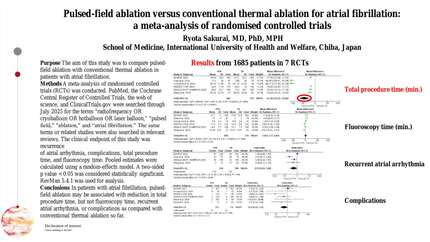
Seven RCTs with 1,006 patients (514 HPSD, 489 CPD) were included. No significant differences were found in freedom from arrhythmia during the follow-up period (HR 0.77; 95% CI 0.41–1.45; p=0.424). AF recurrence did not differ (RR 0.94; 95% CI 0.65–1.36; p=0.733) between groups. HPSD had a significantly shorter procedural (MD -22.61 min; 95% CI -33.18, -12.04; p<0.001) and RF ablation (MD -15.70 min; 95% CI -20.86, -10.55; p<0.001) times, with comparable fluoroscopy time (MD 0 min; 95% CI -0.44, 0.45; p=0.99) between groups.
In patients with AF undergoing PVI, HPSD did not increase freedom from arrhythmia as compared with CPD ablation, however it was associated with shorter procedure and RF ablation times. These findings suggest that HPSD may be a more efficient approach without compromising clinical outcomes.
Contributors

A Rivera
Author
M Braga
Author
B Mariz Ferreira Passos
Author
I Ferreira Felix
Author
C Ternes
Author
A Regia Dantas Brigido
Author
G Dagostin De Carvalho
Author
A Deshmukh
Author
C Desimone
Author
You may be interested in