Safety of ventricular tachycardia ablation under deep sedation with propofol and fentanyl, a single center analysis.
European Heart Journal


Abstract
Catheter ablation (CA) is an established treatment of ventricular tachycardia (VT). There is no standard of anaesthetic management for these procedures.
To assess the safety and feasibility of deep sedation with propofol and fentanyl for VT ablation in a single-center experience.
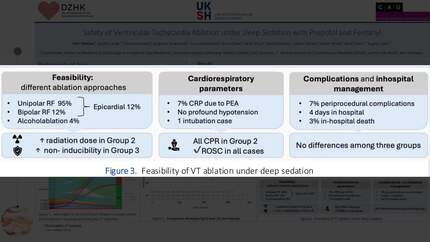
All consecutive CA procedures for VT in our hospital, performed between 01/2022 and 01/2025 were prospectively enrolled (n=134). All procedures were performed under deep sedation with propofol and most (98.5%) with fentanyl. Three groups were defined and compared among each other:Group1:no VT induction (n= 36;26.9%); Group2:induction of at least one hemodynamically unstable monomorphic VT, required termination(n= 43; 31.3%); Group3: induction of hemodynamically stable sustained monomorphic VT could be induced(n=56;41.8%).
A total of 134 procedures were performed in 106 patients. The median age was 64 years (56-72), 83.6% weremale, 130(97%) had structural heart disease (Figure 1). Epicardial access was used in 24 (17.9%) cases. Except for higher prevalence of DCM in Group 2 (33.3% vs 50% vs 25%, p=0.04) and higher prevalence of LVEF<30% in Group 2(19.4% vs 47.6% vs 42.9%, p=0.024), there were no significant differences in baseline characteristics among three groups (Summ.figure).
There were no episodes of profound hypotension during baseline rhythm, necessitating propofol discontinuation. Periprocedural cardiopulmonary resuscitation was performed in 9 cases(6.7%), all of them in group 2(p<0.01) due to pulseless electrical activity following hemodynamically unstable VT. Return of spontaneous circulation was achieved within one minute in all cases and procedures were continued. There were no differences in number and duration of desaturation episodes among three groups. Although SpO2 levels at 160 and 240 minutes were lower in group 2(p<0.01) (Fig.2).Desaturation, requiring intubation happened in 1 patient and was related to cardiogenic shock due to acute coronary artery thrombosis.
Endocardial unipolar radiofrequency CA in LV was performed in 104(81.3%), in RV in 30 (23.4%) and epicardial in 15(11.7%) of procedures. In 16 (11.9%) bipolar ablation and in 5 (3.7%) alcohol ablation were performed; 5(3.7%) of cases were performed with Impella support. Except for higher radiation dose in Group 2 (484.8 vs 1097.9 vs 962.1 cGy,p=0.04) there were no differences in periprocedural parameters among groups.VT non-inducibility after ablation could be achieved in 114 procedures (85.1%).Periprocedural complications occurred in 9(6.7%). Four patients died in-hospital.There were no differences among 3 groups in complication rate, in-hospital mortality and hospitalisation duration.
Catheter ablation of VT under DS with propofol and fentanyl in patients with structucal heart disease is feasible and safe, irrespective of VT induction and ablation approach. Hemodynamical instability, hypotension and desaturation could be effectively managed. Summary figure
Contributors


S Lange
Author
T Kannenberg
Author
A Uckermark
Author
J Nebendahl
Author
S Srouji
Author
J Scherkus
Author
F Moser
Author
A Cluever
Author
D Frank
Author
E Lian
Author
You may be interested in