Impact of radiofrequency versus pulsed-field ablation on gastric motility in patients with atrial fibrillation: findings from a single-center study
European Heart Journal


Abstract
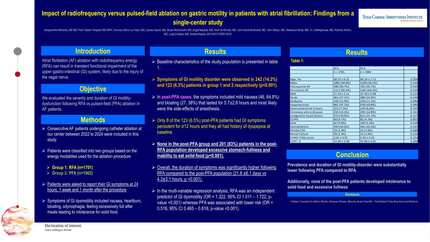
Atrial fibrillation (AF) ablation with radiofrequency energy (RFA) can result in transient functional impairment of the upper gastro-intestinal (GI) system, likely due to the injury of the vagal nerve.
We evaluated the severity and duration of GI motility-dysfunction following RFA vs pulsed-field (PFA) ablation in AF patients.
Consecutive AF patients undergoing catheter ablation at our center between 2022 to 2024 were included in this study and divided into two groups based on the energy modalities used for the ablation procedure; group 1: RFA (n=1701) and group 2: PFA (n=1962). Patients were asked to report their GI symptoms at 24 hours, 1 week and 1 month after the procedure. Symptoms of GI dysmotility included nausea, heartburn, bloating, odynophagia, feeling excessively full after meals leading to intolerance for solid food. A multivariable regression analysis was conducted to identify independent predictors of GI motility symptoms.
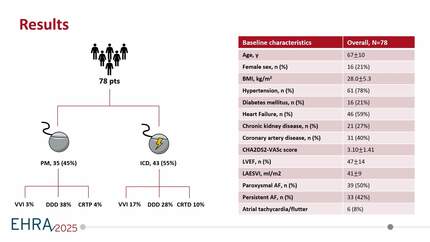
Baseline characteristics were comparable between groups (table).
Symptoms of GI motility disorder were observed in 242 (14.2%) and 123 (6.3%) patients in group 1 and 2 respectively (p<0.001).
In post-PFA cases, the symptoms included mild nausea (46, 64.8%) and bloating (27, 38%) that lasted for 5.7±2.6 hours and most likely were the side-effects of anesthesia. Only 8 of these 123 patients (6.5%) had GI symptoms persistent for ≥12 hours and they all had history of dyspepsia at baseline.
None in the post-PFA group and 201 (83%) patients in the post-RFA population developed excessive stomach-fullness and inability to eat solid food (p<0.001). Overall, the duration of symptoms was significantly higher following RFA compared to the post-PFA population (21.8 ±6.1 days vs 4.3±3.1 hours, p <0.001).
In the multivariable analysis, RFA was an independent predictor of GI dysmotility (OR = 1.322, 95% CI 1.011 – 1.722; p-value <0.001) whereas PFA was associated with lower risk (OR = 0.516, 95% CI 0.465 – 0.818; p-value <0.001).
Prevalence and duration of GI motility-disorder were substantially lower following PFA compared to RFA. Additionally, none of the post-PFA patients developed intolerance to solid food and excessive fullness. Baseline table
Contributors

P G Torlapati
Author
V M La Fazia
Author
C A R O L A Gianni
Author
B Macdonald
Author
A Mayedo
Author
A Al-Ahmad
Author
J D Burkhardt
Author
J Allison
Author
W Bode
Author
G J Gallinghouse
Author
R Horton
Author
L Di Biase
Author
A N D R E A Natale
Author
You may be interested in