Impact of left atrial posterior wall isolation on atrial contractile function assessed by intracardiac echocardiography in patients with atrial fibrillation
European Heart Journal


Abstract
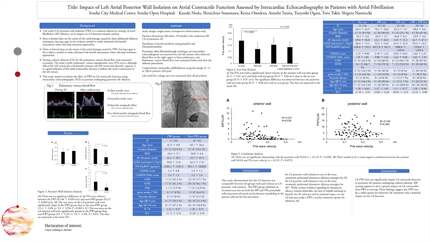
Catheter ablation for atrial fibrillation (AF) has evolved, with pulmonary vein isolation (PVI) becoming a standard treatment. Despite various techniques, success rates for maintaining sinus rhythm range from 70% to 90%. Additional strategies like posterior wall isolation (PWI) have been explored, but their routine use remains controversial. This study aimed to investigate the impact of left atrial posterior wall isolation on atrial contractile function using intracardiac echocardiography-derived atrial systolic pulmonary vein flow.
This single-center observational study involved 64 patients undergoing radiofrequency catheter ablation for persistent AF. Patients were divided into PWI (n=17) and non-PWI (n=47) groups. Intracardiac echocardiography measured pulmonary vein atrial reversal wave (PVa) velocity as an indicator of left atrial contractile function. Scar areas in the anterior and posterior walls were analyzed using voltage mapping. Patients were categorized based on scar presence in the anterior and posterior walls. Statistical analyses included Student's t-test, Pearson's chi-square test, one-way ANOVA with Bonferroni correction, and correlation analysis.
The PWI group showed significantly larger scar areas in the left atrial posterior wall compared to the non-PWI group (13.2 ± 3.4% vs. 5.8 ± 3.9%, P < 0.001). However, no significant difference was observed in PVa wave velocity between the PWI (0.146 ± 0.050 m/s) and non-PWI groups (0.157 ± 0.069 m/s). When categorizing patients based on scar presence, four groups were identified: no scar (21 cases), anterior wall scar only (10 cases), posterior wall scar only (13 cases), and both anterior and posterior wall scars (20 cases). PVa wave analysis revealed significantly lower velocities in the anterior wall scar only group and the both walls scar group compared to the no scar group. Notably, no significant difference in PVa wave velocity was observed between the posterior wall scar only group and the no scar group. Correlation analysis showed a weak trend towards correlation between anterior wall low-voltage areas and PVa wave velocity (r = -0.221, P = 0.079), while no significant relationship was found with posterior wall low-voltage areas (r = -0.129, P = 0.309).
Left atrial posterior wall isolation does not significantly impair left atrial contractile function. Anterior wall scarring appears more closely associated with reduced left atrial contractility than posterior wall isolation or scarring. While PWI's efficacy in AF treatment remains debatable, its minimal impact on left atrial function suggests it may be a potential option for refractory atrial fibrillation, particularly with emerging techniques like pulse field ablation.

You may be interested in