Impact of early intervention with catheter ablation on long-term outcome and disease progression in patients with paroxysmal AF: a single-center analysis
European Heart Journal


Abstract
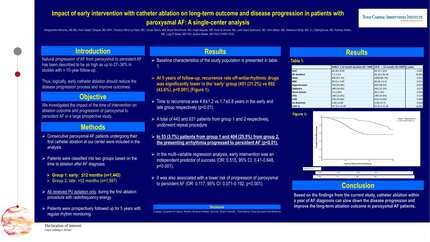
Atrial fibrillation (AF) naturally progresses over time from paroxysmal to persistent/permanent AF. This progression has been described to be as high as up to 27–36% in studies with > 10-year follow-up. Thus, logically, early catheter ablation should reduce the disease progression process and improve outcomes.
We investigated the impact of the time of intervention on ablation outcome and progression of paroxysmal to persistent AF in a large prospective study.
Consecutive paroxysmal AF patients undergoing their first catheter ablation at our center were included in the analysis. Patients were classified into two groups based on the time to ablation after AF diagnosis; 1) early: ≤12 months and 2) late: >12 months.
All received PV isolation only, during the first ablation with radiofrequency energy. Patients were prospectively followed up for 5 years with regular rhythm monitoring.
A total of 1,442 and 1587 patients were included in the ‘early’ and ‘late’ group respectively. Baseline characteristics of the study population is provided in Table 1. At 5 years of follow-up, recurrence rate off-antiarrhythmic drugs was significantly lower in the ‘early’ group (451 (31.2%) vs 692 (43.6%), p<0.001). Time to recurrence was 4.6±1.2 vs 1.7±0.8 years in the early and late group respectively (p<0.01).
A total of 442 and 631 patients from group 1 and 2 respectively, underwent repeat procedure.
At the time of redo, the AF type continued to be paroxysmal AF (no progression) in 389 (27%) and 227 (14.3%) patients in group 1 and 2 (p<0.01).
In 53 (3.7%) patients from group 1 and 404 (25.5%) from group 2, the presenting arrhythmia progressed to persistent AF (p<0.01).
In the multi-variable regression analysis, early intervention was an independent predictor of success (OR: 0.515, 95% CI: 0.41-0.648, p<0.001). It was also associated with a lower risk of progression of paroxysmal to persistent AF (OR: 0.117, 95% CI: 0.071-0.192, p<0.001).
Based on the findings from the current study, catheter ablation within a year of AF diagnosis can slow down the disease progression and improve the long-term ablation outcome in paroxysmal AF patients.
Contributors

P Torlapati
Author
V M La Fazia
Author
C Gianni
Author
B Macdonald
Author
A Mayedo
Author
A Al-Ahmad
Author
J D Burkhardt
Author
J Allison
Author
W Bode
Author
G J Gallinghouse
Author
R Horton
Author
L Di Biase
Author
A N D R E A Natale
Author
You may be interested in