Impact of low hemoglobin levels on arrhythmia recurrence after radiofrequency catheter ablation of atrial fibrillation
European Heart Journal


Abstract
While risk factors for arrhythmia recurrences after catheter ablation of atrial fibrillation (AF) have been investigated, the impact of hemoglobin (Hb) levels has not been fully evaluated. During radiofrequency catheter ablation (RFA), lower Hb levels contribute to reduced blood pool impedance, leading to a loss of radiofrequency currents into the blood pool, which may result in smaller lesion formation. Additionally, lower Hb levels are known to exacerbate cardiac overload, potentially contributing to atrial cardiomyopathy. This study aimed to assess the impact of lower Hb levels on arrhythmia recurrences after RFA of AF.
We enrolled patients who underwent initial RFA of AF with pulmonary vein (PV) isolation at our Hospital between September 2014 and April 2024. Arrhythmia recurrences were defined as documented AF or atrial tachycardia (AT) on 12-lead electrocardiograms, or AF/AT episodes lasting >30 seconds on 24-hour or 7-day Holter ECG monitoring, after 90-days blanking period. Patients were categorized into four groups based on Hb level quartiles. Hazard ratios (HRs) were calculated after adjusting for common risk factors for arrhythmia recurrence, including age, sex, AF type, left atrial diameter, and chronic kidney disease.
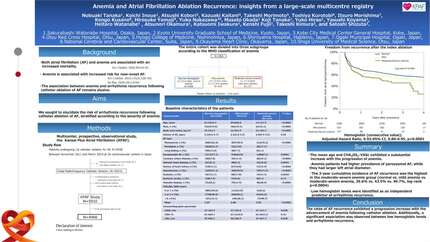
A total of 1,665 patients were enrolled. The mean age was 70.0±10.5 years, 623 patients (37%) were female, and 787 patients (47%) had paroxysmal AF. During a median follow-up of 728 days, arrhythmia recurrences were observed in 546 patients (33%). The cutoff values for the first, second, and third quartiles of Hb levels were 12.4, 13.7, and 14.8 g/dL, respectively. Patients in the lowest Hb quartile (Q1) had significantly lower arrhythmia-free survival than those in higher quartiles (p=0.001, log-rank test, Figure). After adjusting for common risk factors, lower Hb levels in Q1 were associated with a higher risk of arrhythmia recurrence after RFA (HR 1.39, 95% confidence interval 1.13–1.70, p=0.002). In the redo procedures performed in 318 patients, any PV reconnection was more frequently observed in patients in Q1 than in those in higher quartiles (43/70 patients (61%) vs. 133/248 patients (54%), p=0.244), though the difference was not statistically significant.
Lower Hb levels were associated with an increased risk of arrhythmia recurrence after RFA of AF. This association may not be fully explained by a higher rate of PV reconnections, suggesting that additional mechanisms may be involved. Further investigations are needed to clarify the impact of low Hb levels, even in patients undergoing more durable PV isolation strategies.
Contributors


Y Egami
Author
N Kobayashi
Author
A Sugino
Author
M Abe
Author
H Nohara
Author
S Kawanami
Author
K Yasumoto
Author
N Okamoto
Author
M Yano
Author
M Nishino
Author
You may be interested in