The efficacy of low-voltage-area ablation enhances in patients with advanced left atrial enlargement: a subanalysis of SUPPRESS-AF trial
European Heart Journal


Abstract
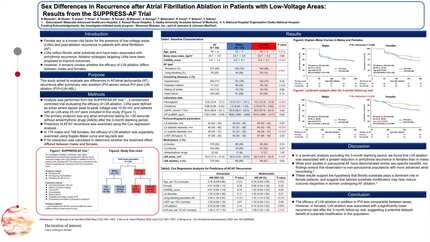
A randomized controlled SUPPRESS-AF trial showed that the efficacy of low-voltage-area (LVA) ablation was highly dependent on the degree of atrial remodeling, while the efficacy was not statistically significant in total patients.
The purpose of this subanalysis of SUPPRESS-AF trial was to compare the efficacy of LVA ablation in each patient group classified according to left atrial diameter (LAD) which is commonly used atrial remodeling index.
SUPPRESS-AF trial included persistent AF patients with left atrial LVAs and compared rhythm outcomes between patients randomized to undergo pulmonary vein isolation (PVI) followed by left atrial LVA ablation (LVA-ABL group, n=170) or PVI alone (PVI-alone group, n=172). In this post-hoc sub-analysis, the patients in the either of the two randomly allocated groups were further divided into 2 groups using a median LAD of 44 mm.
There was no difference in AF/AT recurrence-free rates between patients with LAD > 44 mm and ≤ 44 mm (60.1% vs. 53.7%, p=0.261). Among patients with LAD > 44 mm, LVA-ABL group demonstrated higher AF/AT-recurrence-free rate than PVI-alone group (62.5% vs. 43.4%, p = 0.016, Figure 1). On the other hand, no difference in AF/AT recurrence-free rate was found between the 2 groups in patients with LAD ≤ 44 mm (60.8% vs. 59.6%, p=0.986). Hazard ratios of AF/AT recurrence in the LVA-ABL group to the PVI-alone group stratified by left atrial revealed that the efficacy of LVA ablation appears to become more pronounced with increasing LAD (Figure 2).
The efficacy of LVA ablation in addition to PVI for the treatment of persistent AF was more pronounced in patients with a large left atrium.


You may be interested in