Development of a PFA index to guide energy delivery with a force sensing flexible, irrigated tip catheter
European Heart Journal


Abstract
Pulsed field ablation (PFA) is a novel energy modality; factors predicting lesion diameter and transmurality are not well understood. Realtime integration of factors associated with lesion formation is crucial to maximizing procedural efficacy and efficiency.
To identify individual factors that predict PFA lesion growth and to derive a multivariable model to predict lesions suitable for contiguous and transmural atrial ablation using a force sensing flexible, irrigated tip catheter.
In an acute swine model, 152 ventricular lesions were created with PFA using the TactiFlex SE PFA catheter. The number of bursts and contact forces were varied. A multifactorial probabilistic model was fitted to lesion dimensions and optimized using an ROC approach to predict likelihood of a therapeutic atrial lesion (depth ≥4 mm, width ≥ 5mm; A).
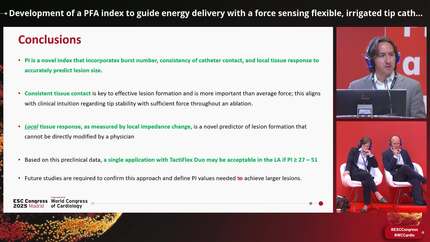
The 3 most predictive factors to attain the above dimensions were number of bursts delivered, percentage of time that the contact force is at least 5g, and change in local bipolar tissue impedance. The incorporation of these factors into a model, the PFA index (PI), scored 0-100, resulted in high prediction accuracy for applications of an R-wave gated 5-burst, 2400V waveform (AUC=94%, n=85; B). PI values increase across individual bursts (C, D) and successive applications at the same site (E, F). The mean PI value for 5 bursts delivered with a mean force ≥ 5g was 70 (n=48), and the median depth was 5.2 mm with a median absolute deviation (MAD) of 2.3 mm (N=9). 94% of lesions (47/50) with PI ≥ 70 met the dimensional criteria.
The median depth at 10 bursts (2 applications) delivered with a mean force ≥ 5g was 6.8 mm, with a MAD of 1.75 mm (N=12). A PI of ≥ 90 was obtained after at least 10 bursts delivered with a mean force ≥ 5g in 93% of lesions (50/54).
The PI algorithm combines PFA bursts, contact force, and local impedance change to accurately predict lesions sufficient for pulmonary vein isolation and linear ablation. Prospective studies are planned to confirm the impact on procedural outcomes.

You may be interested in