Hybrid convergent epicardial and endocardial ablation in patients with persistent or long-standing persistent atrial fibrillation: a single-center experience
European Heart Journal


Abstract
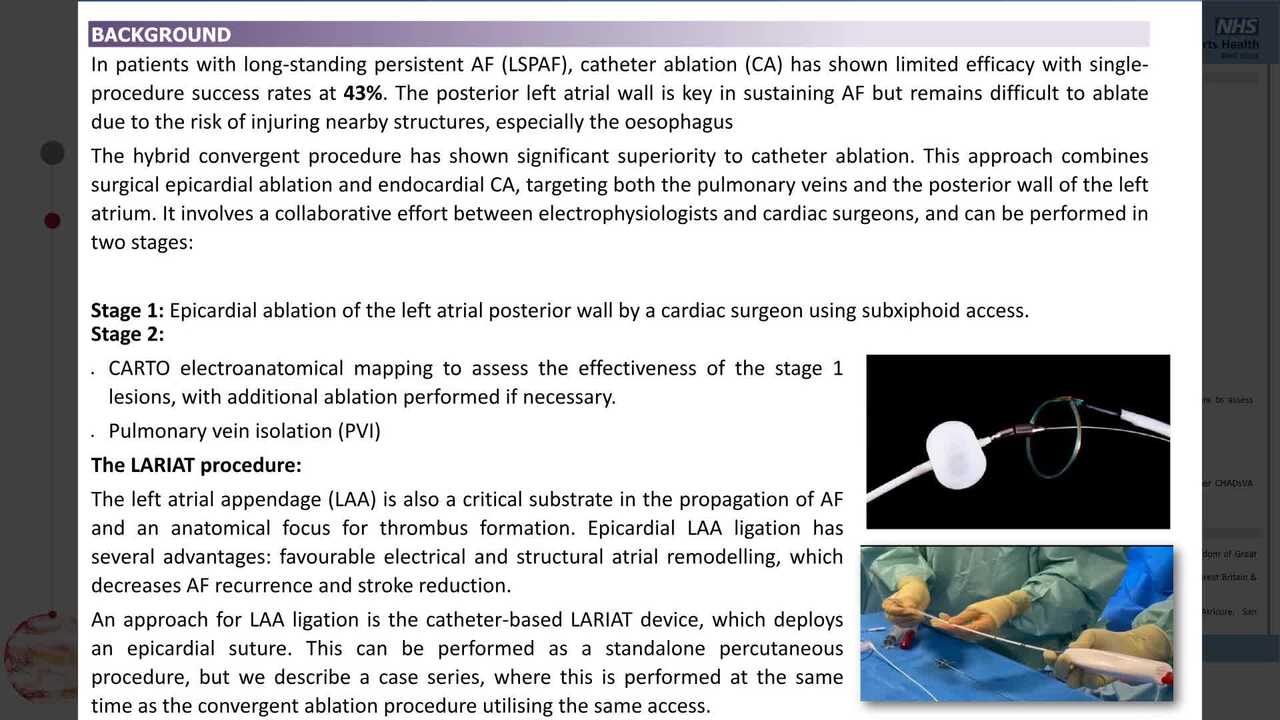
Endocardial catheter ablation of persistent (PsAF) and long-standing persistent atrial fibrillation (LSPsAF) is associated with suboptimal outcomes. The hybrid "Convergent" two-stage surgical ablation procedure is associated with improved long-term outcomes, but real-world evidence remains limited.
We characterized the efficacy of the Convergent procedure with concomitant left atrial appendage (LAA) exclusion in achieving arrhythmia-free survival among patients with PsAF or LSPsAF.
Single-center retrospective study of 65 patients who underwent the Convergent procedure from 2021-2023 for PsAF (n=36) or LSPsAF (n=29). The primary endpoint was one-year freedom from any documented atrial tachyarrhythmia (AT) >30 seconds after a 90-day blanking period.
Mean age was 67.5 ± 10.3 years, there was a male predominance (78.5%), mean BMI of 29.2 ± 5.0 kg/m2, and mean LA volume index was 42.4 ± 14.9 ml/m2. LAA clipping was performed in 98.5% of patients, and the Ligament of Marshall was divided in 67.7% of patients. In the cohort, 24.5% had prior AF catheter ablation, and mean number of failed antiarrhythmic drugs (AADs) was 0.60 ± 0.7. Overall freedom from any AT at one year was 77.7%, without AADs in 89.4% of patients. We found no significant difference in the primary endpoint for patients with PsAF vs LSPsAF (76.9% vs 78.9%, log-rank p = 0.96). There was a 3.1% post-procedural complication rate.
The Convergent ablation procedure with concomitant LAA exclusion confers excellent freedom from recurrent AT at one year and should be considered in PsAF or LSPsAF patients.
Contributors


M N Jiang
Author
H Nguyen
Author
C Macias
Author
Y Krokhaleva
Author
H Khakpour
Author
P Benharash
Author
E F Buch
Author
You may be interested in